witn
Outcome-based billing infrastructure for AI agent builders that verifies results before charging.
Overview
witn is a specialized billing infrastructure designed for companies building AI agents. Instead of charging for tokens, API calls, or seat time, witn enables outcome-based pricing where customers pay only for verified results. The platform sits between an agent's activity stream and the invoicing system, evaluating events against predefined success criteria and settling charges only when outcomes are confirmed. This approach addresses a growing pain point in the AI industry: traditional usage-based billing often fails to align with the value agents deliver, leading to customer distrust and churn. witn positions itself as the bridge between agent activity and customer value, offering a way to monetize AI agents that feels fair and transparent.
The product targets AI agent builders across verticals including customer support, coding, SRE, and voice. It integrates with existing event tracking tools like Segment, Rudderstack, PostHog, and Stripe, so teams can adopt it without overhauling their stack. The company also provides a free downloadable report, "AI Agent Monetization: The Complete Guide," which covers pricing models and operational best practices.
Key Features
Outcome Definition in Plain English – Users define what constitutes a successful outcome using simple language, without needing to write complex rules. Conditions can be adjusted from the dashboard at any time, allowing pricing models to evolve with the product.
Event Forwarding from Existing Systems – witn works with whatever event tracking infrastructure a team already uses. Agents send events to witn, which then evaluates them against the defined outcome conditions. No new instrumentation or data pipelines are required.
Real-Time Outcome Resolution – As events arrive, witn updates the state of each outcome in real time. When a billable condition is met, the outcome becomes pending. A settlement window (configurable up to 180 days) allows for reversals before charges become final. This prevents billing for results that later fail, such as a support ticket that gets reopened.
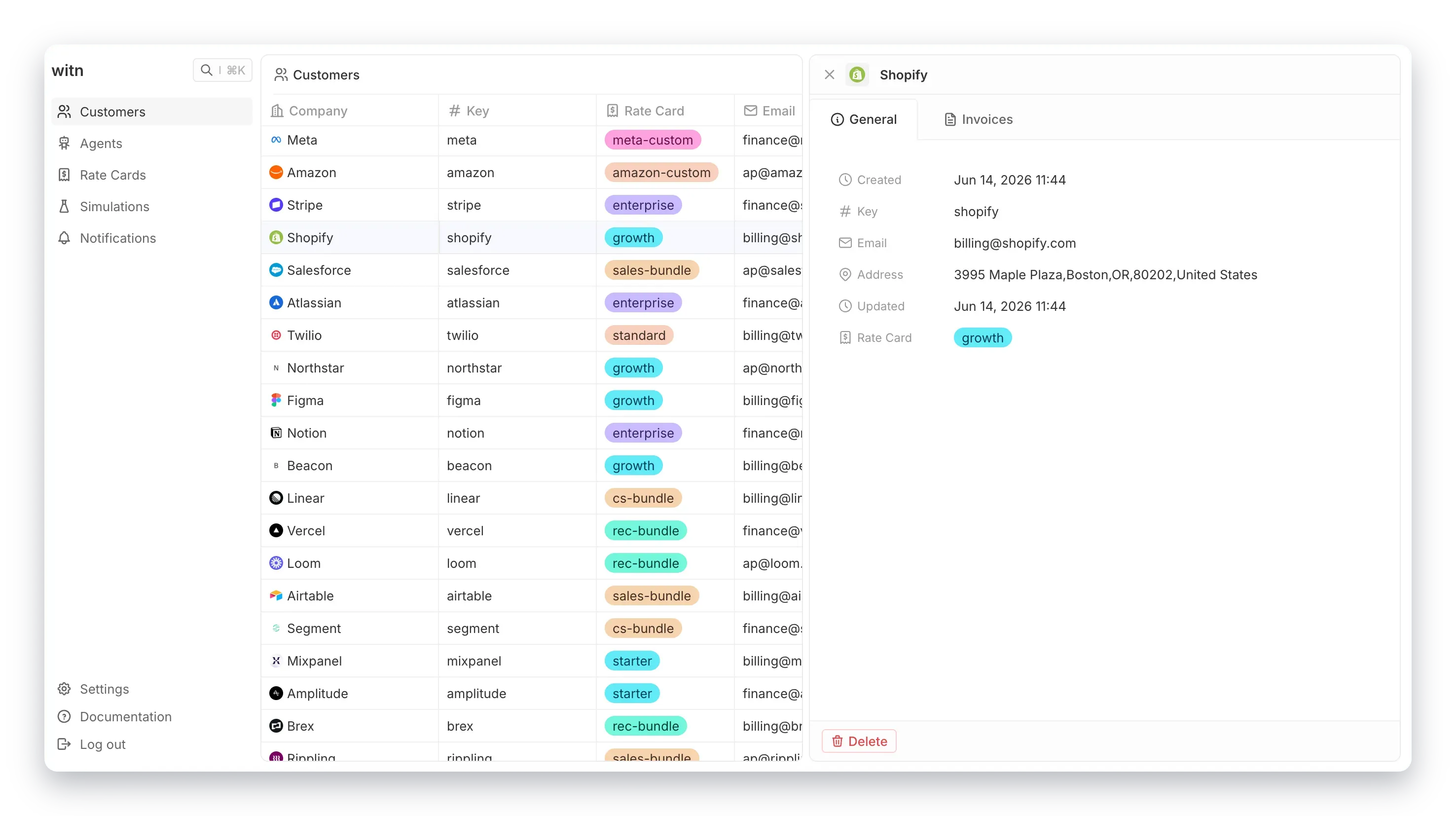
Per-Customer Contracts – Each customer can have custom products, prices, and outcome definitions without forking billing logic. This is critical for B2B AI agents where contracts vary widely. The dashboard provides a single view of all customer-specific terms.
Simulation and Historical Replay – Before shipping changes to pricing or outcome conditions, users can replay historical events through the new logic to see how outcomes and revenue would shift. This reduces the risk of unintended billing changes.
Auditable Event Trail – Every signal and decision is recorded in order, so teams can answer customer disputes without digging through logs. Each invoice line item carries the context of how the outcome was reached, which also supports revenue recognition under ASC 606.
Integration with Popular Tools – witn connects with Segment, Rudderstack, PostHog, and Stripe out of the box. This allows teams to send events from their existing analytics pipelines and sync invoices with their payment processor.
How It Works
The process begins with defining outcome terms in the witn dashboard. A user specifies what a successful outcome looks like in plain language, such as "a support ticket that stays closed for 72 hours" or "a pull request that is merged and not reverted within 5 days." These conditions are stored as billable conditions.
Next, the agent sends events to witn through its API or via integrated event pipelines. Each event contains relevant signals about the agent's work. witn evaluates these events against the billable conditions in real time. When a condition is satisfied, the outcome moves to a pending state.
A settlement window begins. During this period, if a reversal event occurs (e.g., the ticket is reopened), the outcome resets to unresolved. If the window expires with the condition still holding, the outcome is confirmed and becomes billable. witn then produces invoice line items with a full event trail, which can be sent to Stripe or another billing system.
Teams can monitor all outcomes from the dashboard, run simulations to test pricing changes, and manage per-customer contracts without code changes. The entire flow is designed to minimize manual reconciliation and provide transparency to both the vendor and the customer.
Use Cases
Customer Support Agent – A company deploys an AI agent to resolve support tickets. With witn, they define a successful outcome as a ticket that is resolved and not reopened within 72 hours. The agent sends events for each ticket interaction. witn tracks the state and only bills for tickets that stay closed. Customers trust the billing because they only pay for results that stick.
Code Review Agent – An AI coding assistant helps developers merge pull requests. The company sets the outcome condition to "PR merged and not reverted within 5 days." Events include PR creation, comments, merge, and revert. witn confirms the outcome after the settlement window, ensuring the code change was stable before charging.
SRE Monitoring Agent – An AI agent monitors infrastructure and auto-remediates issues. The outcome is defined as "incident resolved with no recurrence within 24 hours." Events include alert triggers, remediation actions, and status updates. witn bills only for incidents that stay resolved, aligning cost with value delivered.
Voice Agent for Sales – A voice AI handles outbound sales calls. The outcome is a qualified lead that results in a meeting booked. Events include call transcripts, lead scoring, and calendar events. witn verifies the meeting actually happened before billing, preventing disputes over call quality.
Multi-Agent Platform – A platform offering multiple AI agents uses witn to manage billing across different agent types. Each agent has its own outcome definitions and rate cards. Per-customer contracts allow different pricing for enterprise clients. The simulation feature helps test new pricing models before rolling them out.
Pricing & Value
witn does not publicly list pricing on its website. Instead, the company offers a 30-minute demo and a free downloadable report. This suggests a custom pricing model based on usage volume, number of outcomes, or enterprise requirements. For early-stage startups, this lack of transparent pricing can be a barrier to evaluation. However, for companies already generating revenue from AI agents, the value proposition of reducing billing disputes and aligning pricing with customer-perceived value can justify the investment.
The free report, "AI Agent Monetization: The Complete Guide," provides 17 pages of practical advice on pricing models, verification, and operations. This resource is valuable for teams exploring outcome-based billing.
Final Verdict
witn addresses a genuine gap in the AI infrastructure stack: billing that reflects actual value delivered. Its outcome-based approach is well-suited for AI agents where results are discrete and verifiable. The real-time resolution, settlement windows, and auditable trails provide the transparency that enterprise customers demand. The simulation feature is a standout, allowing teams to experiment without risk.
Areas for improvement include the lack of public pricing, which makes initial evaluation harder, and the reliance on event quality from the agent. If an agent sends incomplete or inaccurate events, outcome verification may suffer. Additionally, the platform is still relatively new, so the ecosystem of integrations and community resources is limited compared to established billing platforms.
witn is best suited for AI agent companies that want to move away from usage-based billing and build trust with customers through verified outcomes. Teams with complex, multi-step agent workflows will benefit most from the per-customer contracts and simulation capabilities. For simpler billing needs, traditional usage platforms may suffice, but for those seeking alignment between price and value, witn offers a compelling solution.
For more details, visit the witn documentation or read the blog for case studies and comparisons. The glossary also provides definitions of key terms used in outcome-based billing.
Pros & Cons
The Good
- Outcome-based billing aligns charges with actual value delivered, reducing customer disputes over token or API usage.
- Real-time outcome resolution with configurable settlement windows prevents billing for results that later fail.
- Per-customer contracts allow custom pricing and outcome definitions without forking billing logic.
- Simulation and historical replay let teams test pricing changes against past events before going live.
- Auditable event trail provides full context for every charge, supporting revenue recognition under ASC 606.
The Bad
- No public pricing information is available, requiring a demo call for cost evaluation.
- Relies on accurate and complete event data from the agent; poor event quality can undermine outcome verification.
- As a newer platform, the integration ecosystem and community resources are less mature than established billing solutions.