CertWorthIt
CertWorthIt counts 362,748 job ads across 10 countries to show how often employers actually name PMP, CCNA, AWS and CompTIA certifications.
Overview
CertWorthIt is a research site that measures how often employers name a certification in job advertisements. Rather than repeating vendor claims about prestige, it counts mentions inside postings drawn from the Adzuna job board API and uses AI text analysis to classify and publish the results as percentages or raw counts. The current snapshot covers 362,748 job ads from ten countries, tracks 78 certifications with job-ad data, and carries a data date of October 2026. Pages are published in English, Portuguese, Spanish, French, German, Italian and Polish.
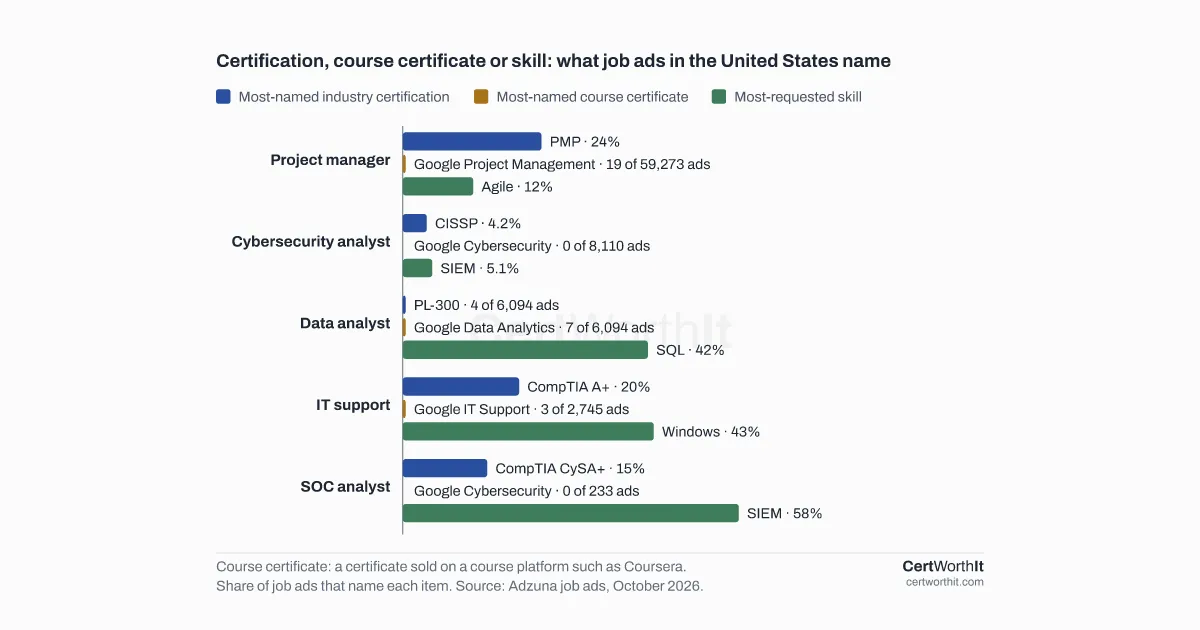
The editorial angle is comparative rather than promotional. Each headline chart places three items side by side for a given occupation: an industry certification, a course certificate, and a general skill. In the United States sample, PMP appears in 24 percent of project manager ads, Agile in 12 percent, and the Google Project Management certificate in 19 of 59,273 postings. For data analyst roles, SQL appears in 42 percent of ads while the Google Data Analytics certificate appears in 7 of 6,094. The same gap recurs in cybersecurity analyst, IT support and SOC analyst postings, and the site states the result directly: in five of five tracked United States roles, the top skill is named more often than the course certificate.
The audience is anyone weighing exam fees, training subscriptions and study time. That includes career changers moving into IT support or data work, project managers comparing CAPM with PMP, security practitioners choosing between CISSP and OSCP, and advisers or bootcamp staff who need a citable source rather than an anecdote. CertWorthIt is operated by Lumavera OU, registered in Tallinn, Estonia, and edited by Jere Salmisto. Affiliate links are disclosed on the site, and the footer states that they never change a verdict.
Key Features
- Mention rates for 78 certifications. Each certificate page reports the share of relevant job ads that name it. PMP reaches 24 percent of United States project manager ads, CompTIA A+ reaches 20 percent for IT support, CCNP reaches 20 percent for network engineers, ITIL reaches 7.8 percent for system administrators, and CISSP reaches 4.2 percent for cybersecurity analysts.
- Industry certification versus course certificate versus skill tables. The home page separates a vendor credential, a course certificate and a core skill for the same job. Google Cybersecurity appears in 0 of 8,110 cybersecurity analyst ads and 0 of 233 SOC analyst ads, while SIEM appears in 5.1 percent and 58 percent of those same ad sets.
- Certificate lookup with autocomplete. A search index of certificates and jobs answers a typed query such as PMP, CCNA or AWS, and offers the quiz or the A to Z list when nothing matches. Frequently checked entries are surfaced directly, including PMP, CCNP, CCNA, CAPM and ITIL.
- Field hubs with a headline figure. Seven fields group the catalogue: Cloud and DevOps with 20 certifications and AWS at 3.8 percent, Cybersecurity with 15 and OSCP at 73 percent, Data and analytics with 11 and Databricks certification at 173 of 21,791 ads, IT support and networking with 9 and CompTIA A+ at 20 percent, Project management with 9 and PMP at 24 percent, AI with 6 and AI-900 at 0 of 7,726 ads, and Agile and Scrum with 4 and SAFe at 22 percent.
- Role-based entry points. Eight role pages cover project manager, AI engineer, data engineer, network engineer, cybersecurity analyst, cloud engineer, system administrator and data analyst, each led by the most-named certification for that job in the United States.
- Country rankings and head-to-head comparisons. Ranking pages name the leader per market, with OSCP at 73 percent in the United States, CCNP at 14 percent in the United Kingdom and PMP at 24 percent in India, plus an all-countries view. Comparison pages such as CAPM versus PMP, CCNA versus CCNP and CISSP versus OSCP list both share figures on one line.
- Quiz, email report and monthly newsletter. A four-question quiz routes visitors by experience level and goal. A country report can be generated without an email address, then optionally mailed, and an opt-in newsletter covers month-over-month movement in the ad data, one new study, and newly added certifications.
How It Works
A visitor arrives with a specific decision in mind, usually a certification name and a target job title. The home page opens with the finding rather than an explanation, showing the United States comparison chart and a short table that reveals the underlying numbers for five roles. Navigation then splits into four paths: searching a certificate directly, browsing a field, starting from a job title, or taking the four-question quiz that asks for experience level, goal and country.
Generating a report requires no account and no email. Two optional questions shape the output, and the report is built from static data files hosted per country, so the figures match the ones shown on the site. Emailing the report is a separate, optional step with a country selector and an email field, followed by a confirmation link.
Certification and comparison pages act as the terminal destination for most sessions. Each carries the mention share, the underlying ad counts, the date of the sample and a link to the methodology page, which documents the Adzuna source and the AI-assisted classification process. Newsletter subscribers receive a digest of which certifications moved up or down, which is the main way the site signals changes between data snapshots.
Use Cases
A help desk technician with two years of tickets is deciding between CompTIA A+ and a cloud credential. The IT support and networking field page shows CompTIA A+ at 20 percent of relevant ads, while the Cloud and DevOps hub shows AWS at 3.8 percent, giving a rough sense of relative demand before any money is spent.
A project coordinator comparing an entry-level credential with an established one opens the CAPM versus PMP comparison. The page places 1.7 percent next to 24 percent, and the PMI-ACP versus PMP page shows 1.1 percent against 24 percent, framing the seniority gap between the credentials rather than the difficulty of the exams.
A data analyst considering a course certificate sees the data analyst row on the home page, where Google Data Analytics appears in 7 of 6,094 ads and PL-300 in 4 of 6,094, while SQL appears in 42 percent. The comparison suggests where study hours might have more effect.
A recruiter or bootcamp instructor preparing curriculum material uses the field hubs and country rankings to cite a source with a date rather than a survey. A job seeker in the United Kingdom, India, Brazil or Poland uses the localized edition and country ranking to check whether the market leader at home differs from the United States result.
Who It's For
CertWorthIt serves job seekers and career changers in IT, data, cloud, cybersecurity, project management and agile roles, plus the people who advise them: bootcamp instructors, university career services, recruiters and technical writers. It is most useful when a decision hinges on relative demand rather than on whether a certification is respected in principle.
Alternatives include vendor certification pages, salary surveys such as the Global Knowledge or Skillsoft reports, course marketplaces, and community forums, all of which tend to describe difficulty, salary bands or personal experience. CertWorthIt occupies a narrower niche by counting employer language in live job ads and reporting the share, with the trade-off that a single ad data source limits how far the numbers can be generalized outside the ten countries tracked.
Pros & Cons
The Good
- Publishes certification mention rates drawn from 362,748 real job ads rather than vendor surveys, with every figure linked back to its source.
- Places industry certifications, course certificates and core skills in the same chart, which makes the gap between them immediately visible for five tracked roles.
- Covers 78 certifications across ten countries with localized editions in seven languages and per-country ranking pages.
- Generates a country report without requiring an email address, and the four-question quiz gives undecided visitors a starting point.
- Discloses its data source, editor, operating company and affiliate relationships in the footer of every page.
The Bad
- All counts derive from a single job-ad source, the Adzuna API, so employers who post only on other boards are underrepresented.
- Course certificates frequently appear in single-digit counts, which makes small differences between them statistically unstable.
- The dataset is a periodic snapshot dated October 2026 and limited to ten countries, so fast-moving markets may not be fully reflected.