SourceX
SourceX helps companies license operational work records to AI labs, handling rights review, privacy preparation, contracts, delivery and one-time payment.
Overview
SourceX is an enterprise data transaction layer built for the artificial intelligence era. Based in Los Angeles, the company sits between two constituencies that rarely negotiate directly: businesses that accumulate operational records as a byproduct of daily work, and the AI labs that need that material to train and refine models. Support conversations, engineering histories, sales cycles, approved legal documents and internal knowledge bases represent context that public web crawls cannot supply. SourceX handles the commercial, legal and technical work of turning those records into a licensable dataset under a single relationship rather than a patchwork of brokers. The offering targets organizations with 50 or more full-time employees at peak headcount in the United States, Canada or the European Union.
Key Features
- End-to-end transaction management: SourceX runs the entire deal through five defined stages labelled Supply, Rights, Preparation, Approval and Delivery. Each stage is documented before any data is released, and the supplying company retains control at every checkpoint rather than handing records into an opaque pipeline.
- No-upload fit assessment: The qualification process consists of five short questions covering employee headcount, years of operating history, company status, industry and data type. No files are uploaded and no commitment is required, letting a business evaluate potential fit without exposing any records.
- Rights review before licensing: Before any license is signed, SourceX reviews the rights attached to the data and requires supplier confirmation. The company states that rights are reviewed before any license is issued, and the approval stage explicitly requires authorization from the supplying business.
- Privacy preparation and de-identification: Personal details are removed during dataset-specific preparation. An illustrative packet structure lists where the data came from, the licensing rights, permitted uses, the privacy process and the release record. Names and company identifiers in the displayed example are replaced with bracketed placeholders.
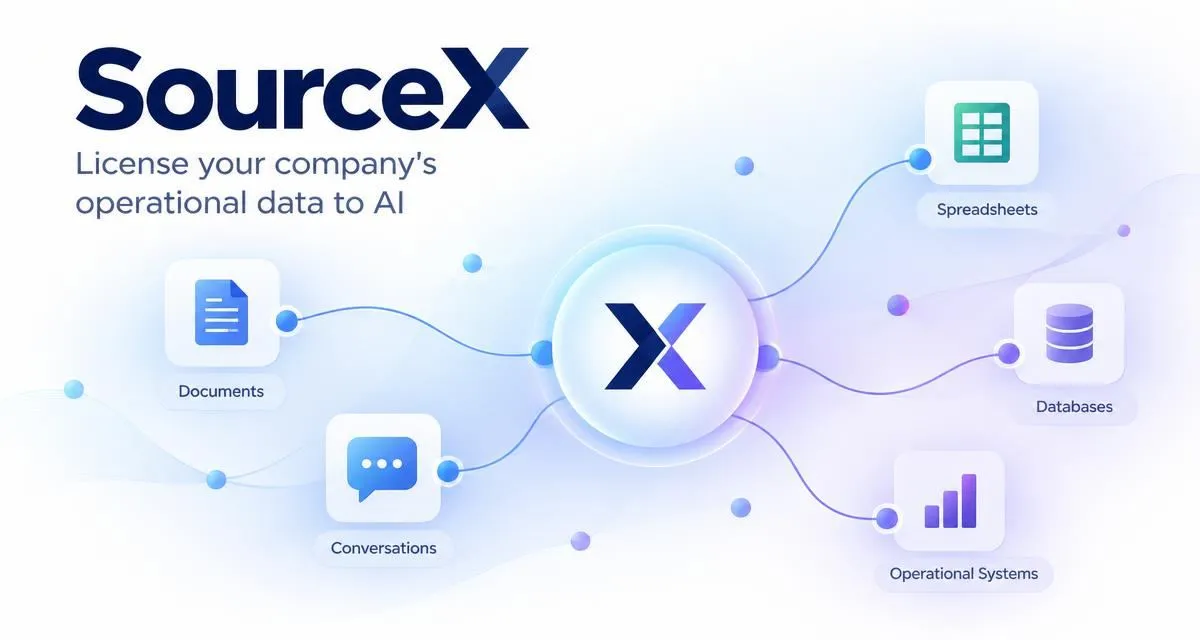
- Broad source system compatibility: The platform accepts exports and records from customer support tools such as Zendesk, Intercom and Salesforce Service Cloud; CRM platforms including HubSpot, Microsoft Dynamics 365 and Pipedrive; engineering systems such as GitHub Enterprise, GitLab and Jira; document repositories including SharePoint, Google Drive, Box and Confluence; and finance or legal systems such as NetSuite, Xero, iManage and DocuSign CLM.
- Supplier approval before delivery: Nothing leaves the company until the supplier approves. Scope, permitted uses and exclusivity terms are written into the signed agreement, and the supplier reviews those terms before agreeing to them.
- Published trust and legal documentation: A trust center, a legal framework page, standard deal terms and a security program status listing give prospective suppliers material to review independently. A plain-text summary file is also published specifically for AI assistants.
How It Works
The process begins with a fit check. A company answers five questions about headcount, operating history, current status, industry and data type, then receives an indicative assessment without uploading anything. If the profile looks suitable, SourceX moves to the Supply stage, where the relevant records, scope and potential licensing fit are defined. The Rights stage follows, covering supplier confirmation and review of licensing rights. Preparation comes next, where the dataset is readied for a specific buyer and personal details are stripped. Approval is the gate before release: the supplying company authorizes what is shared and how it may be used. Delivery completes the sequence, after which payment is issued. A posted walkthrough video runs under a minute and shows the workflow on real platform screens with labelled examples.
Use Cases
- Customer support and communication: Support cases, escalations and expert responses that demonstrate how real customer problems get resolved. A contact center or BPO with years of ticket history could package resolved conversations, once personal details are removed, for labs training models on troubleshooting and dialogue.
- Software engineering workflows: Engineering histories connected to operational tasks, capturing the chain of issue, review, resolution and outcome. A software company with a long repository history and linked issue tracker could supply records showing how expert decisions get made in context.
- Documents and domain knowledge: Approved documents, structured records and accumulated domain knowledge from legal, consulting or accounting practices. A law firm with a large corpus of finalized contracts could license the structure and reasoning embedded in those documents.
- Sales and CRM activity: Sales cycles, call recordings and pipeline records held in platforms such as Salesforce, HubSpot or Gong show how commercial conversations progress from first contact to close.
- Finance and operations records: Systems like NetSuite, QuickBooks and Xero hold structured operational data that reflects how businesses actually run.
Who It's For
SourceX suits established businesses with roughly 50 or more full-time employees at peak headcount, several years of operating history and operations in the United States, Canada or the European Union. Companies still running, already acquired or wound down can all qualify. The offer is less relevant to early stage startups without substantial record volume. Alternatives include negotiating directly with AI labs, working through general data marketplaces or building an internal licensing function. SourceX competes on managing the legal, privacy and delivery work in one place.
Pros & Cons
The Good
- SourceX manages the complete licensing lifecycle, from rights review and de-identification through contracting, delivery and payment, so suppliers do not need to assemble their own legal and data teams.
- The qualification check requires no file uploads and only five questions, allowing a company to gauge fit before any disclosure takes place.
- Release is gated on explicit supplier authorization, and personal details are removed before any dataset is shared with a buyer.
- Source system compatibility is broad, spanning Zendesk, Intercom, Salesforce, HubSpot, GitHub Enterprise, Jira, SharePoint, NetSuite and DocuSign, among others.
- A published trust center, legal framework and standard deal terms give prospective suppliers documentation to inspect before entering negotiations.
The Bad
- Eligibility is narrow, since companies generally need 50 or more full-time employees at peak plus several years of operating history, which excludes smaller organizations.
- Exclusivity terms are standard, typically preventing a supplier from licensing the same data elsewhere for AI training during the exclusivity period.
- Once SourceX selects data in writing and pays the fee, the license is permanent, and specific pricing figures are not published on the site.