PrivateTechShares
PrivateTechShares helps founders and employees value private startup equity, model exercise cost and dilution, and prepare for a US or European secondary sale.
Overview
PrivateTechShares is an independent information and tools resource built for people who hold equity in private companies. It targets founders, co-founders, serving and former employees with stock options, and early angel investors who need a defensible view of what their shares or vested options are worth before any liquidity event. The platform combines free calculators, sourced country tax guides and paid preparation toolkits, with coverage spanning the United States and seven European markets. It deliberately does not broker transactions, hold shares or introduce buyers. Instead it prepares holders to assess value, exercise cost, dilution and tax so they can act with professional advisers rather than guesswork.
Key Features
Free stake estimator with share class and liquidity adjustments. The headline tool accepts a share count, the per-share price from the most recent funding round, the type of holding (common shares, unexercised vested options or investor-class preferred shares) and the company stage together with buyer demand. It returns a realistic sale range rather than a single figure, illustrating how common shares typically trade below the preferred price investors paid. A strike price field appears when options are selected, and currency can be switched between euros, dollars and pounds. Virtual or phantom units such as German VSOP are excluded from the model with a pointer to the country guides.
Option exercise calculator with a US AMT variant. A second free tool estimates the cash required to convert vested options into real shares, the paper spread against the last round, and rough tax treatment for Poland, Germany, France and the United Kingdom. A separate US version layers in alternative minimum tax and ordinary income considerations, which matters for holders facing the roughly ninety-day exercise window that follows departure.
Seven-country tax and transfer playbooks. Guides cover Germany, the United Kingdom, France, Spain, Italy, the Netherlands and Poland, each carrying cited and dated figures aligned to the 2026 tax year. The material addresses capital gains treatment, notarisation requirements and transfer mechanics rather than generic definitions.
US and European Equity Toolkits at $39 or 39 euros. The paid products centre on an eight-phase A to Z deal map with explicit STOP points marking where a lawyer, tax adviser or notary must take over. Each bundle includes a live Excel calculator for net proceeds and offer comparison, a Deal Room control panel, a readiness audit, editable Word documents and eleven ready-to-send messages. The US edition adds ISO, NSO, AMT and QSBS material, and a combined bundle sells for 59 euros.
Equity Position Report with optional human review. For $129, a personalised report applies the company's published methodology to an individual grant, returning a shareable position summary, valuation scenarios before and after tax, exercise cost, dilution modelling, an exit waterfall after investor preferences, country tax treatment and a conversation pack of questions for advisers and buyers. Adding expert human review raises the price to $249.
Company guides for more than 250 private businesses. Individual pages cover OpenAI, Anthropic, SpaceX, Stripe, Databricks, Revolut, Monzo, Helsing, Anduril, Celonis, Rippling, Mistral AI, Scale AI, N26, Trade Republic, Discord, Perplexity, Glean, Whatnot and Vinted, among others, with a clear disclaimer that no affiliation or endorsement exists.
Equity Starter Kit and transferability check. A free PDF outlines the private sale journey, the factors that drive value, a plain English glossary and a first company-request letter. A four-question interactive check on holding type, vesting status, right of first refusal and transaction size routes visitors toward relevant guides without storing any answers.
How It Works
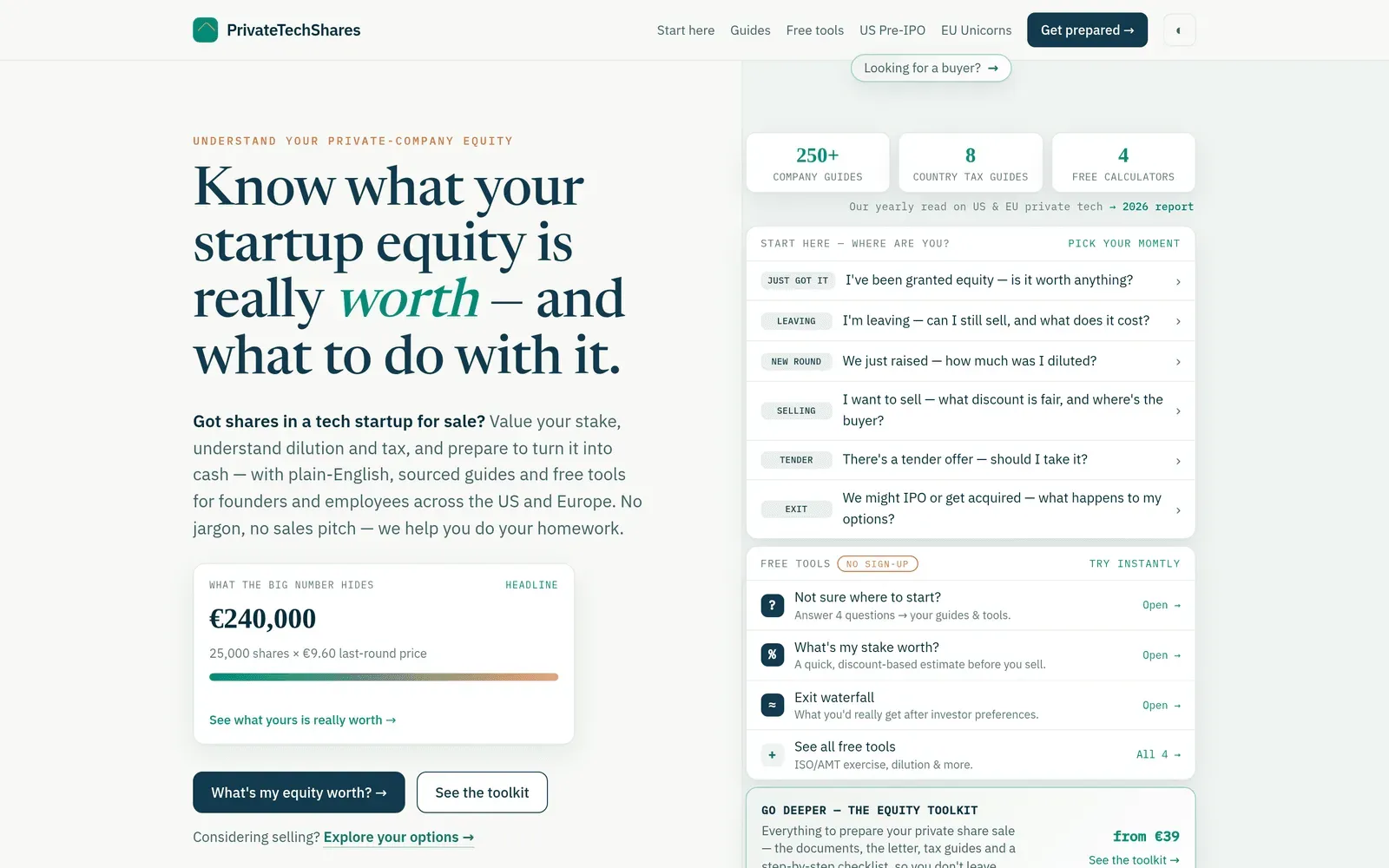
Visitors begin by locating their situation. The homepage presents a journey selector mapping six moments to specific content: newly granted equity, departure from the company, a fresh funding round, an active intention to sell, an incoming tender offer, and an exit event such as an IPO or acquisition. Each entry links to a dedicated guide.
From there, a holder runs the free estimator with a handful of inputs and reads the resulting range alongside the gap between headline value and realistic sale price. A squeeze visual on the homepage makes the same point numerically, showing how a headline valuation can compress once share class, illiquidity and buyer demand are applied. The exercise calculator handles the option-specific question of what it costs to convert grants into transferable shares, while the can-I-sell check clarifies whether vesting and transfer restrictions permit a sale at all.
Paid products sit at the end of that path and are delivered as instant downloads through Stripe, with PDF, Word and Excel components plus a thirty-day money-back guarantee. The site states plainly that it holds no shares, brokers no sales and takes no transaction cut.
Use Cases
A former employee holding vested options faces a ninety-day exercise deadline after leaving a company. The exercise calculator establishes the cash outlay and paper spread, the US variant adds alternative minimum tax exposure, and the relevant country guide flags the tax event triggered at exercise rather than at sale.
A founder with a modest stake wants partial liquidity without a full exit. The estimator prices a slice against the last round and applies a discount for common shares in an early or illiquid business, while the guide explains how a right of first refusal or board approval is cleared as routine paperwork rather than treated as a dead end.
A European employee at a late-stage company such as Vinted, N26 or Trade Republic needs to know how a secondary sale is taxed locally. The country playbooks for Germany, France, Spain, Italy, the Netherlands and Poland supply dated figures and notarisation notes, and a separate comparison page positions the offering against institutional venues such as Forge, EquityZen and Nasdaq Private Market.
A holder facing a tender offer wants an independent read before accepting. The dilution and exit waterfall tools show what investor preferences would absorb, and the estimator compares the offer against a modelled private sale discount.
Someone holding virtual or phantom units, such as a German VSOP, learns early from the estimator's guidance that cash-settled instruments cannot normally be sold on a secondary market and must be handled through the employer's plan terms.
Who It's For
The platform is aimed at founders, co-founders, serving and former employees with ESOP grants, and early angel investors across the United States and Europe. It suits holders of small stakes who fall below the minimums of institutional secondary venues. Large platforms such as Forge, EquityZen and Nasdaq Private Market target late-stage, high-value transactions and institutions, whereas PrivateTechShares offers preparation and education without executing trades. Readers seeking a brokerage, a guaranteed buyer or regulated legal counsel will find the site stops short of that service and points to qualified professionals instead.
Pros & Cons
The Good
- Free, no-signup calculators cover equity valuation, option exercise cost and a four-question transferability check.
- Country-specific tax and transfer playbooks span the US, Germany, the UK, France, Spain, Italy, the Netherlands and Poland with dated 2026 source figures.
- Paid toolkits bundle an eight-phase deal map, a live Excel calculator, a Deal Room control panel and eleven ready-to-send messages for $39 or 39 euros.
- Dedicated guides exist for more than 250 private companies including OpenAI, SpaceX, Stripe, Revolut and Mistral AI.
- Explicit STOP points flag where a lawyer, notary or tax adviser takes over, reducing the risk of a self-run sale.
The Bad
- The platform does not broker sales or introduce buyers, so holders must still locate and negotiate with a counterparty independently.
- Paid toolkits and reports are educational templates and starting-point drafts rather than jurisdiction-checked legal documents.
- Most operational depth sits behind the $39 to $249 paid tiers, while the free tools only produce rough indicative ranges.