UltraBall
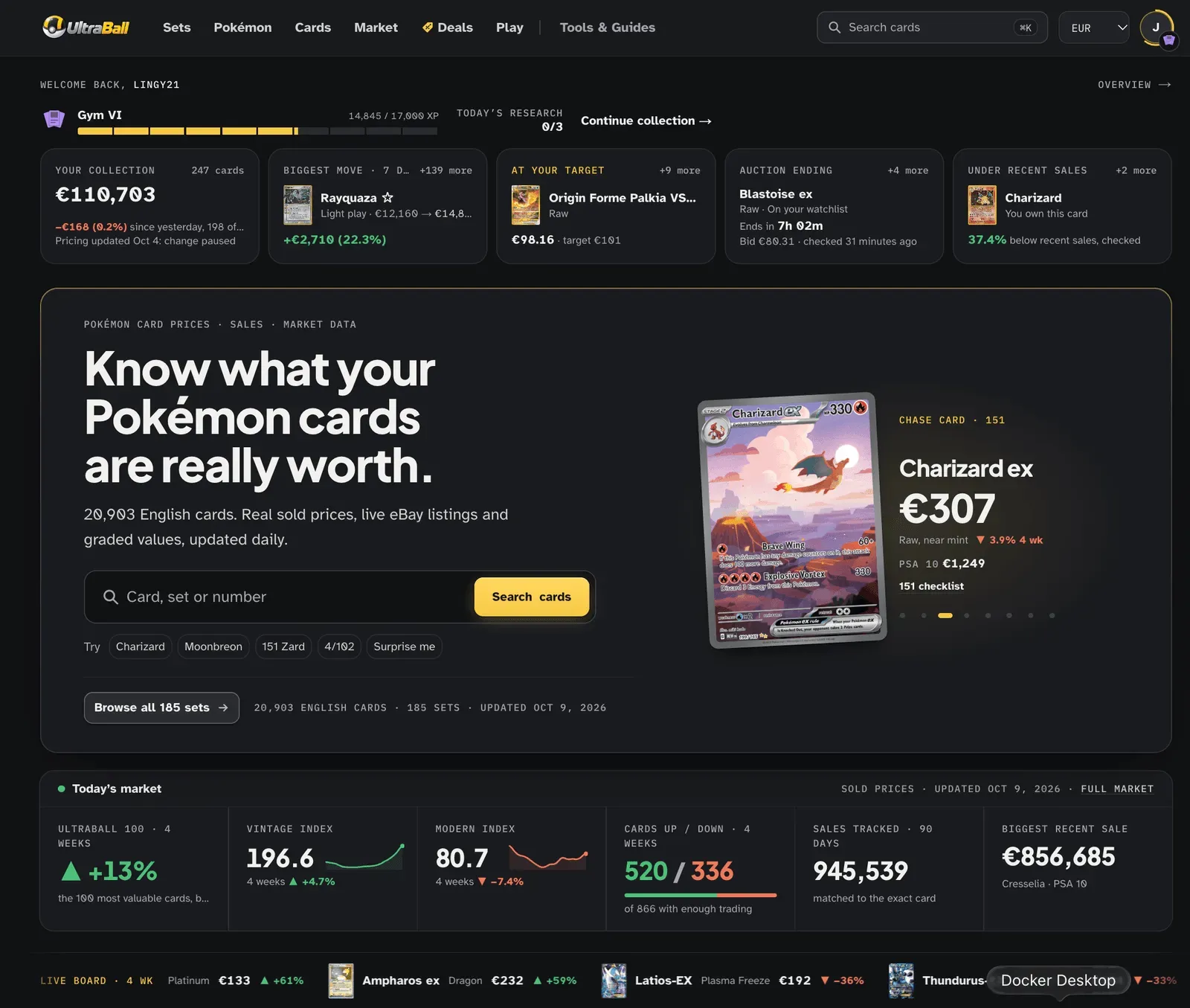
UltraBall tracks live prices, graded values and recent sales for 20,903 English Pokémon cards across 185 sets, updated daily.
Overview
UltraBall is a price and market data resource for English Pokémon trading cards, covering 20,903 cards across 185 sets that stretch from the 1999 Base Set to the 30th Celebration release. It targets collectors, resellers, graders and market watchers who need a defensible number attached to a card instead of a single asking price pulled from one marketplace listing. Every card page combines an ungraded price with a four week change figure, a graded price ladder, a price chart, liquidity and confidence markers, and the specific sales UltraBall has recorded for that card. The product sits closer to a market data terminal than a storefront, and the company states directly that its values are estimates rather than offers to buy or sell. The core promise is straightforward: someone holding a binder or weighing a slab submission can look up a card and see what the market has actually paid for it recently, in raw and graded condition, instead of guessing from a handful of screenshots.
Key Features
- Daily-refreshed pricing on 20,903 English cards: The database spans 185 sets and refreshes on a daily cycle, with the homepage timestamping the most recent update. Vintage releases such as Base Set and Fossil sit in the same index as modern Mega Evolution sets, so older print runs and current releases can be compared without switching between sources.
- Grader-specific value ladders: PSA, CGC, BGS, SGC and TAG prices are tracked separately and never blended into one averaged grade figure. A PSA 10 value reflects PSA 10 sales only, which matters because the same card can trade at meaningfully different levels depending on which holder it sits inside.
- Market indexes for trend tracking: UltraBall publishes composite indexes including the UltraBall 100, Vintage, Modern, PSA 10, Raw and a Charizard-specific index. The homepage currently displays a Vintage reading of 196.6 against a Modern reading of 80.7, giving a quick read on how older print runs are performing relative to current releases.
- Liquidity and confidence labelling: Every price carries a signal about how many copies sold, how recently, and how easily a card in that condition actually moves. The methodology page explains that thin evidence is labelled rather than hidden, so a card with two sales in six months is visibly distinguishable from one that trades every day.
- Sales matched to the exact card: UltraBall reports 925,164 sales tracked over a 90 day window, each matched to the specific card rather than to a broad search term. Card pages list recent comparable sales beneath the headline price, and listings that remain for sale are kept in a separate bucket from completed transactions.
- Set, era and rarity navigation: The catalog is organised by 185 sets, eleven eras running from Wizards of the Coast through Mega Evolution, and rarity classes including Special Illustration Rare, Alternate Art, Gold Star and Shining. Supporting pages cover set symbols, sets by year, release dates, sealed product prices, collector nicknames such as Moonbreon and Van Gogh Pikachu, and illustrator indexes.
- Collector tools and deal hunting: A toolset includes an AI card grader, a card centering tool, a grading calculator, a selling calculator, a collection tracker and a price checker. On the buying side, Deals on eBay, Sniper for auctions with a maximum bid, Slab Hunter for raw cards worth grading, plus auctions ending soon and price drop feeds round out the offering.
How It Works
A visitor lands on a search field that accepts a card name, a set name or a collector number. Queries can be typed freely or seeded with shortcuts such as Charizard, Moonbreon, 151 Zard or a literal card number like 4/102. Results lead to a card page that opens with the ungraded market value, the four week movement, and a graded ladder broken out by grader and grade. Below that sits a price chart, liquidity and confidence marks, and a list of the individual sales UltraBall has recorded, each with a date and, where relevant, a grader.
From there the workflow branches in several directions. A seller can run the same card through the selling calculator to see what a net payout looks like after fees. A grader-curious collector can compare the raw price against the graded price to judge whether the spread justifies submission, or use the centering tool and grading calculator as a rough pre-screen before paying for a submission. A market watcher can move up to the market section and read the indexes, the most traded list, record sales or the low population report. Account holders can save a watchlist and build a collection, while the fantasy portfolio and daily card challenge add a lighter, game-like layer on top of the data.
Use Cases
A collector clearing out a loft finds a stack of Base Set holos and needs to know whether the Charizard at the top of the pile justifies a grading fee. Looking up the Base Set Charizard shows a raw value around $634 and a PSA 10 figure well above it, along with the number of copies sold in the previous 90 days, which indicates whether a graded copy would find a buyer quickly or sit for months.
A reseller scanning eBay auctions wants to bid with a hard ceiling. The Sniper tool filters auctions against a maximum bid, while the price drop and new listing feeds surface cards that have moved recently, using UltraBall values as the reference point for what a fair number looks like.
A set builder working through 151 wants to know what completion costs. Set pages publish an approximate set value, so 151 shows roughly $1,773 across 207 cards with Charizard ex flagged as the chase card. That single figure makes it possible to estimate remaining spend without pricing every missing card individually.
A modern investor watching the broader market compares the Vintage index at 196.6 against the Modern index at 80.7 to judge whether older nostalgia print runs or current releases are carrying momentum. Separate index pages for PSA 10 and Raw slice the same question by condition, which is useful when grading premiums widen or compress.
Someone sorting a childhood collection that may include a counterfeit can use the guide on spotting fake Pokémon cards and the comparison of 1st Edition, Shadowless and Unlimited printings, then check each specific card against the database to see whether the realistic value is a few dollars or several hundred.
Who It's For
UltraBall is aimed at English-language Pokémon card collectors, resellers, graders and market observers who want sales-backed figures rather than asking prices. It suits people pricing a single card as well as those tracking portfolio-level movement through indexes. Compared with general marketplaces, which show live listings but limited graded separation, UltraBall trades transaction capability for depth of historical sales and condition-specific data. Compared with free checklist databases, it adds pricing, liquidity and market context on top of card metadata. The main constraint is scope: the dataset covers English printings only, so collectors working primarily in Japanese or other language releases will find gaps, and the site does not sell cards itself.
Pros & Cons
The Good
- Tracks 20,903 English cards across 185 sets with prices refreshed on a daily cycle.
- Separates graded values by grader so PSA, CGC, BGS, SGC and TAG markets are never blended together.
- Adds liquidity and confidence markers plus 925,164 sales tracked over 90 days, each matched to the exact card.
- Publishes composite market indexes including the UltraBall 100, Vintage, Modern, PSA 10 and Raw.
- Bundles free collector utilities such as an AI card grader, centering tool, grading calculator and collection tracker.
The Bad
- Coverage is limited to English printings, so Japanese and other non-English releases fall outside the database.
- Values are explicitly estimates rather than offers to buy or sell, and no transactions take place on the platform itself.
- Market depth varies by card, and thin sales evidence is labelled rather than filled in, which leaves obscure cards with weaker price confidence.