White Space Signal
White Space Signal ranks BUILD and BUY opportunities that gain value as AI advances, with dual scorecards and two free number one dossiers.
Overview
White Space Signal is a subscription research service that ranks where economic value is likely to move as artificial intelligence becomes more capable. Rather than tracking AI product launches or compiling startup idea lists, the platform organizes its work around two separate decision tracks: BUILD, which covers new businesses, services, data layers, assurance capabilities and infrastructure worth creating, and BUY, which covers categories of existing businesses that may become more attractive to acquire. The service is aimed at founders, acquisition entrepreneurs, operators, small business owners and private market investors weighing where to commit capital or working years. Full access to the ranking system costs 59 dollars per month, while the current number one BUILD and BUY reports are published without charge.
Key Features
- Separate BUILD and BUY score models. BUILD opportunities are assessed against 18 factors and BUY categories against 20, reflecting that launching a company and acquiring one are fundamentally different economic decisions. The two tracks share an evidence standard but never a single blended scorecard.
- Three-part scoring with Quality, Conviction and White Space. Each ranked entry carries an opportunity strength score out of ten, an evidence strength score, and a measure of how much useful, under-recognized room may remain. The current number one BUILD thesis, a release compatibility regression guard, scores 8.8 for quality, 8.2 for conviction and 7.0 for white space.
- Two full public dossiers. The leading BUILD thesis, covering release checks that stop software updates from breaking support for older customer systems, and the leading BUY thesis, covering recurring utility asset inspection and condition monitoring services, are readable in full without an account or email address.
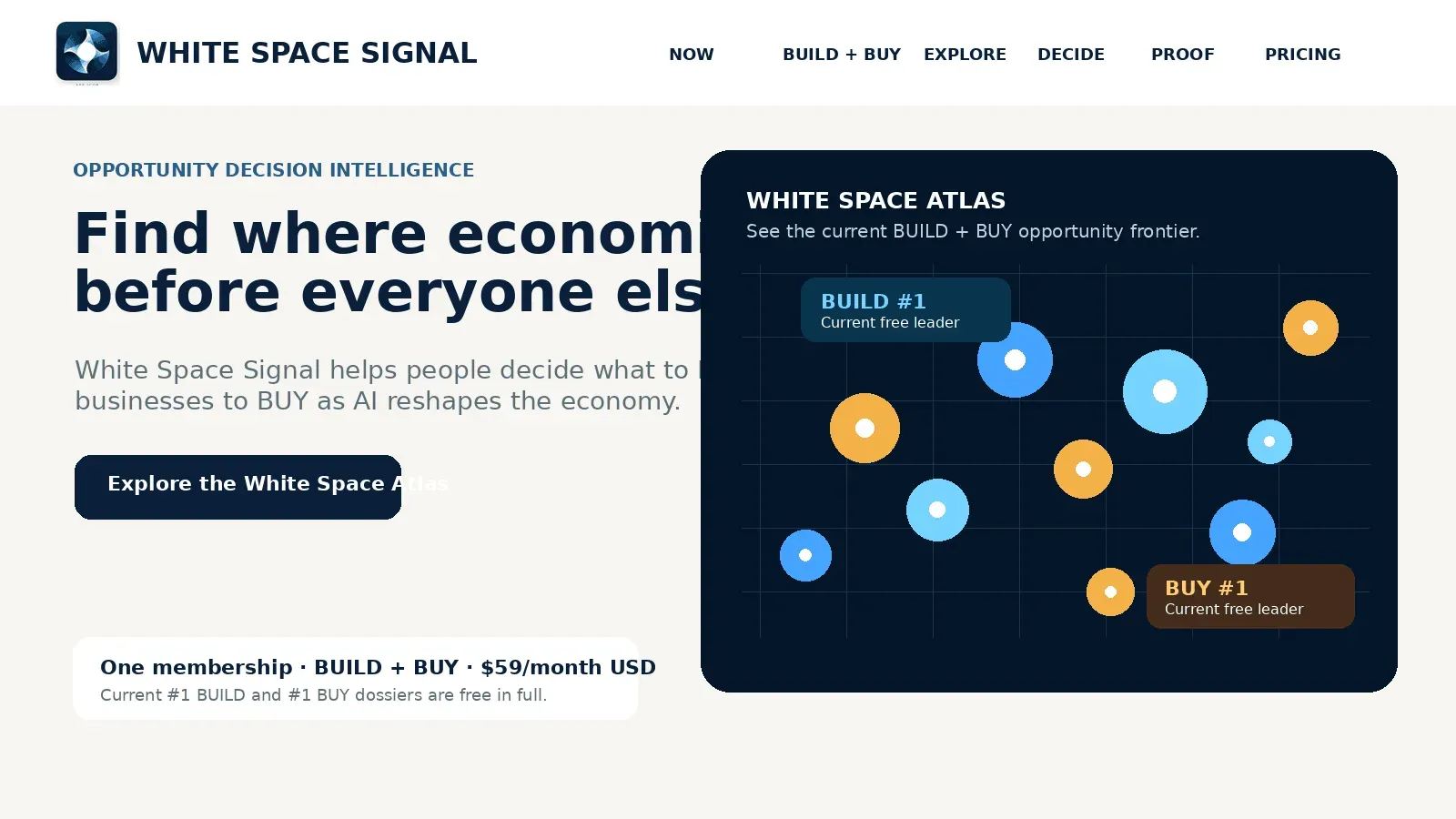
- White Space Atlas frontier map. A visual dashboard plots ranked opportunities by AI compounding strength and commercial quality, with color indicating remaining white space and orb size reflecting conviction. Public visitors see the whole field and the two leaders, while the identities of other ranked entries stay behind membership.
- Emerging opportunity sets. Each ranking can carry up to five Emerging entries that hold enough evidence to warrant attention but not enough to displace a Top 10 position. The platform states what would move each candidate upward and what would remove it from consideration.
- Dated, preserved track record. Every published call is timestamped and historical snapshots are retained, so earlier judgments can be inspected instead of quietly revised. Rankings are reassessed continuously but move only when evidence justifies a change.
- Supporting modules. A membership includes NOW, EXPLORE, DECIDE and a Catalyst and Risk Clock alongside both Top 10 lists, the Emerging sets and the full research dossiers.
How It Works
The research begins with observable shifts in technology, infrastructure, regulation, standards, procurement, robotics and enterprise behaviour. The platform reasons forward from those shifts rather than backward from a preferred idea, tracing a chain in which AI makes something cheaper or more autonomous, a constraint tightens, that constraint acquires an economic cost, and a buyer gains a reason to pay. Candidates are challenged against exact competitors, real buyer budgets, the risk of platform bundling, margin quality and the possibility that reasonable assumptions move. Published dossiers follow a fixed question set: what the opportunity is, why it matters now, who pays, how revenue is generated, what competition exists, what remains open, what could invalidate the thesis and what evidence matters next. A stable rank is treated as a valid outcome rather than a failure to publish.
Use Cases
- A solo software engineer looking for a buildable product can read the free release compatibility dossier and judge whether the described buyer, route to revenue and competitive picture match available skills and capital.
- An acquisition entrepreneur evaluating service businesses can use the BUY track to examine utility asset inspection and condition monitoring, including recurring revenue durability, owner dependence and potential AI-driven margin improvement.
- A private investor screening categories can compare how a thesis holds when AI capability is assumed to rise materially, isolating businesses that depend on today's model limitations rather than on durable constraints.
- An operator with existing cash flow can follow ranking movement over time, watching which candidates enter an Emerging set and which drop out as competitor or regulatory evidence changes.
- A founder open to either path can weigh a BUILD idea against a BUY category using two dedicated scorecards instead of forcing both through a single framework.
Who It's For
The service targets people making real allocation decisions rather than readers browsing trends: founders choosing what to create, acquisition entrepreneurs and small business owners assessing what to own, and private market investors evaluating category durability. Operators tracking which parts of a value chain gain bargaining power as intelligence becomes cheap are also in scope. Alternatives include market research subscriptions, startup databases, idea directories and brokerage listings. White Space Signal behaves more like decision support than market sizing, and it surfaces execution difficulty rather than filtering only for opportunities suited to a solo operator.
Pros & Cons
The Good
- Publishes both current number one BUILD and BUY dossiers in full with no signup or email requirement.
- Uses distinct scoring models, 18 factors for BUILD and 20 for BUY, so starting a company and acquiring one are never judged on the same blended scale.
- Keeps opportunity quality, evidence conviction and remaining white space as separate scores so early but strong ideas are not presented as proven.
- Preserves dated historical rankings, allowing earlier judgments to be inspected rather than rewritten after new evidence arrives.
- Explicitly stress-tests each thesis against stronger future AI, exact competitors, platform bundling and real buyer budgets.
The Bad
- Full access to both Top 10 rankings, the Emerging sets and the White Space Atlas requires a 59 dollar monthly subscription.
- Source weighting and exact score weights remain private, which limits independent replication of how ranks are produced.
- Apart from the two public leaders, the identity of ranked opportunities is locked behind membership, leaving limited public verification of the wider field.