Vibes'n'Feels
Vibes'n'Feels maps photos and 20-second videos to places and feelings, letting users keep moments private or share them briefly.
Overview
Vibes'n'Feels is a mobile app that binds a fresh camera capture, either a photo or a video of up to 20 seconds, to a physical place, an emotion chosen from six emotional spectra, and a defined audience. Produced by developer Pavel Bochkov Rastopchin as a VisioFutura project and offered in English and Russian, the product frames itself as an emotion map of moments and places rather than a conventional social network. Each entry, called a Vibe, carries an emoji, an optional short note, and a precise map pin. The service is limited to adults aged 18 and older and remains in private testing, with Google Play and App Store listings shown as coming soon.
Key Features
- Camera-only capture: A Vibe must begin with a new photo or a video recorded inside the app. Gallery imports are rejected, which keeps the record tied to the moment and location where it was produced. Videos are capped at 20 seconds and require a confirmed account, even when the Vibe is Personal.
- Location-bound pins with a 250 meter limit: Location access is mandatory, and the pin can be dragged no further than 250 meters from the position the device reports. A second location check runs after capture, and significant movement forces a new place selection and a fresh capture. The app does not perform background location tracking.
- Six emotional spectra with emoji refinement: Each Vibe starts in one of six spectra covering Anger, Joy, Love, Sadness, Surprise, and Discomfort. A second layer of expressive emoji, running from smiling faces to celebration and calm symbols, narrows the tone. The app explicitly states that a spectrum adds context without diagnosing a mood or offering mental health advice.
- Three audience tiers with different lifetimes: Personal Vibes remain on the device and are never uploaded. Friends Vibes stay visible for three days to people who are mutual friends at that moment. Everyone Vibes appear on the public map for 24 hours after photos and videos pass a safety check. Personal and Friends sharing are exempt from the public sharing limit.
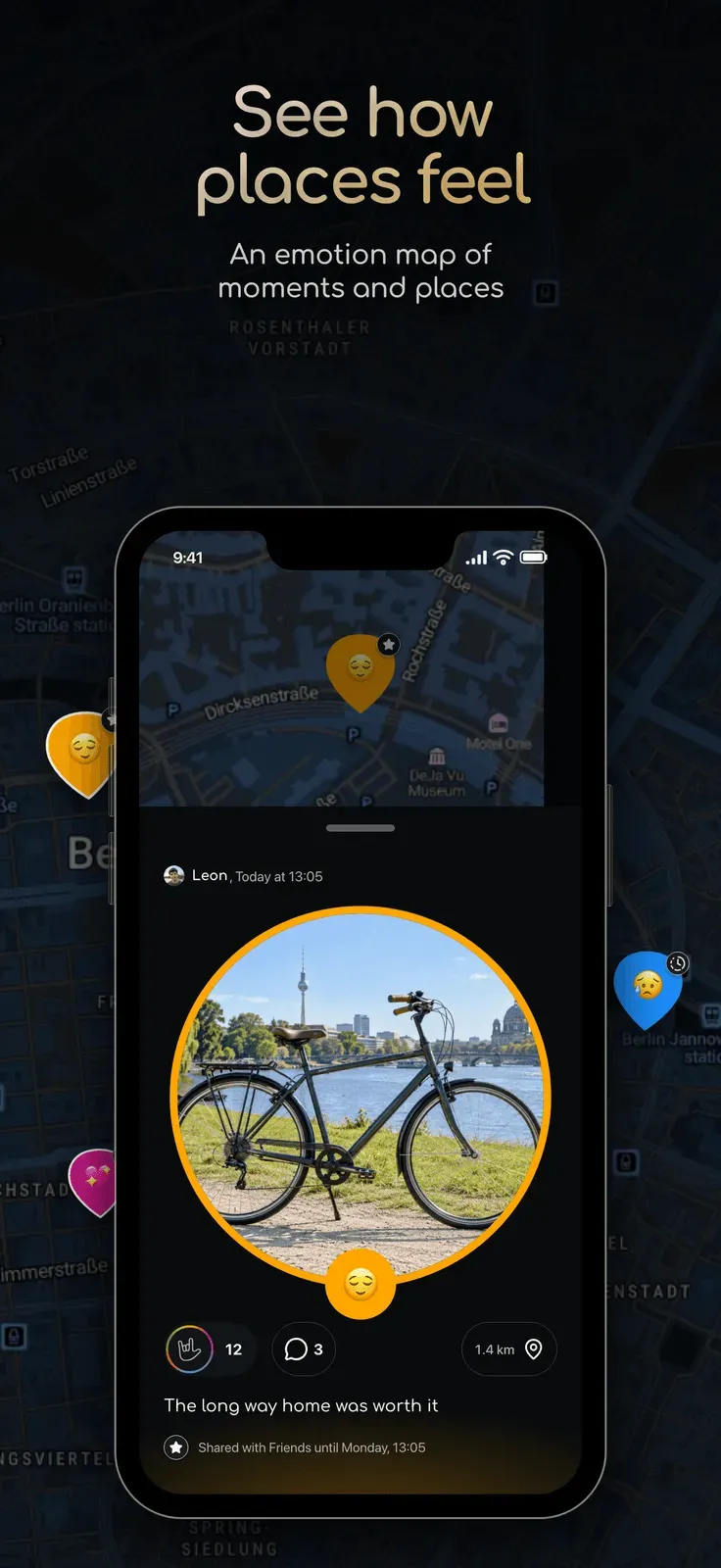
- Map and Feed discovery: Visible Vibes can be browsed geographically or through a chronological Feed. Feed entries display the poster's first name and avatar, distance from the viewer's position, aggregated Feel and comment counts, and a plain-language expiry stamp such as a Friends Vibe that expires the following Monday.
- Feel reactions decoupled from ranking: A Feel is a lightweight response to a single live Shared Vibe. The total is visible, supporter identities are not published, and the count has no effect on discovery, ordering, or promotion.
- Discuss threads that close with the Vibe: Discussion lives inside one live Shared Vibe rather than in a separate inbox. Threads support mentions-only notifications, quote replies from the originating Vibe, and emoji reactions. When the Vibe expires, the conversation disappears with it.
Privacy handling is described in plain terms on the landing page. Camera originals are never uploaded; sharing and sync depend on a processed JPEG for photos or an MP4 with a JPEG poster for video, and shared video may be screened through sampled frames and speech. A confirmed account can synchronize up to 1 GB of the newest eligible Vibes. Friends are mutual and added by exact username, with no people search and no public friend list.
How It Works
Creation runs through five screens. The user first chooses Photo or Video from a New Vibe panel, then places the pin on a map, with copy noting that a shared Vibe exposes that exact pin to its audience while it is live. The camera screen opens next, and the resulting image can be cropped. From there, the emotion screen presents six petals arranged in a ring, each mapped to a spectrum, followed by a refinement row of emoji. Finally, the audience screen offers Personal, Share with Friends, and Share with Everyone, each with its own retention explanation, before the Save Vibe action commits the entry.
Viewing is split between a Map tab and a Feed tab inside the phone interface. A Vibe detail view shows the poster's name, a timestamp, the captured media with its emoji overlay, a distance reading under 100 meters, the optional note, and the audience label. Support surfaces are deliberately narrow: Feels are counted but never attributed publicly, and Discuss threads are bound to the life of a single Shared Vibe. Storage behavior follows the audience choice, with Personal Vibes staying local and shared versions expiring on a fixed schedule.
Use Cases
A visitor walking through Berlin can record a bench at Hackescher Markt with a Love spectrum emoji and a note about having an hour with nowhere else to be, keeping the entry personal as a private diary anchored to a coordinate. The same person might later publish a Sadness Vibe on Torstrasse to Everyone for 24 hours, accepting a short public window without building a permanent post history.
A small group of mutual friends can operate as a private circle. One member posts a Surprise Vibe near Akihabara and shares it with Friends for three days, and the others respond through Discuss with replies and reactions before the thread expires. Because Feels never affect ordering, the group sees entries in sequence rather than by popularity.
Travelers make use of the geographic layer. A Feed entry from a Friend at 3.6 km shows a green glow discovered around a corner, and the distance figure helps decide whether the location is reachable on the same trip. Over time, personal Vibes accumulate into a searchable memory of places and the feelings attached to them.
Who It's For
Vibes'n'Feels targets adults aged 18 and older who want to log how a specific place felt at a specific time without maintaining a public profile, follower base, or popularity metric. It suits people who already keep photo journals but want geographic and emotional context attached, and friend groups that prefer small mutual circles over open audiences.
Compared with BeReal, Instagram Stories, or Snapchat's map layer, the product trades reach for constraint: capture is camera-only, audience tiers expire on fixed clocks, and there are no follower counts, rankings, or direct messages. Compared with mood trackers such as Daylio or Day One, it is not a clinical or diagnostic tool and does not ask users to name a mood. The trade-offs are concrete: location access is non-negotiable, gallery photos cannot be mapped after the fact, and video, Friends, Discuss writing, custom avatars, and sync all depend on a confirmed account.
Pros & Cons
The Good
- Camera-only capture keeps every Vibe anchored to a present moment instead of recycled gallery content.
- Three audience tiers pair visibility scopes with fixed expiry windows, so exposure is bounded by default rather than by manual deletion.
- The 250 meter pin limit and the post-capture location recheck reduce spoofed or remote placements.
- The absence of follower counts, popularity rankings, and direct messages removes the usual engagement incentives from the feed.
- Friends are mutual and added by exact username, with no people search or public friend list.
The Bad
- Location access is mandatory, so a Vibe cannot be created in situations where users prefer not to share coordinates.
- Gallery imports are blocked, which prevents mapping photographs taken before the app was opened.
- Video Vibes, Friends, Discuss writing, custom avatars, and 1 GB sync all require a confirmed account, and the service is restricted to adults 18 and older.