Tsenta
Tsenta is an AI job application agent that auto-applies across 50,000+ career pages and 15+ ATSes in 2026.
Overview
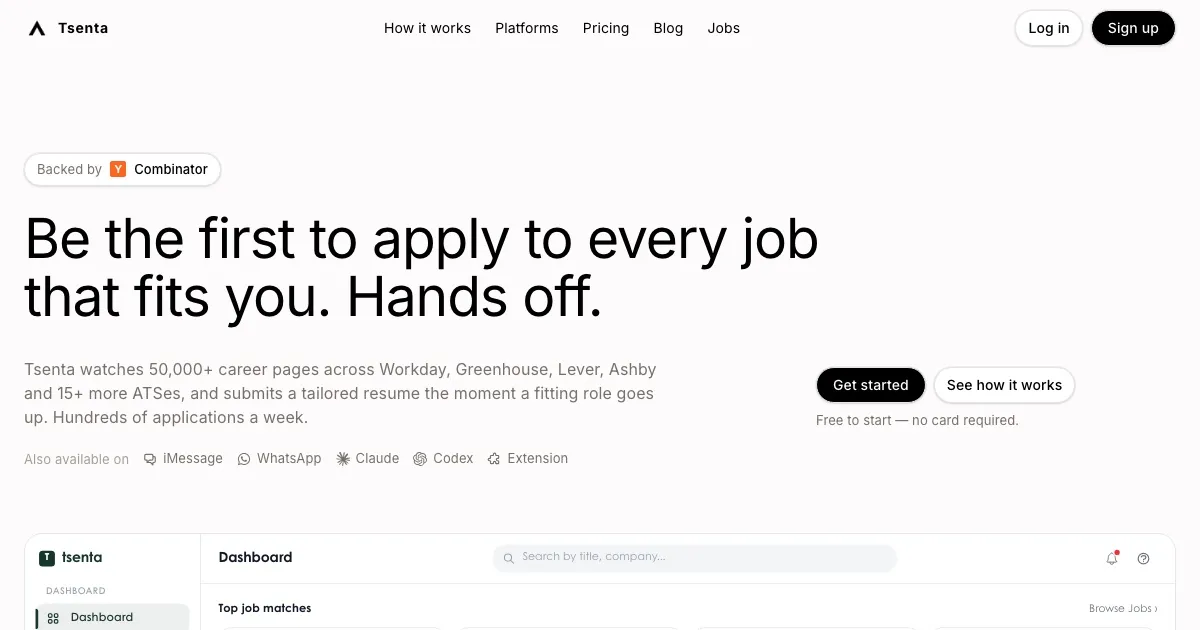
Tsenta is an AI-powered job application agent that automates the entire job search and application process. Backed by Y Combinator, the platform monitors over 50,000 company career pages across 19 different applicant tracking systems (ATS) including Workday, Greenhouse, Lever, and Ashby. When a role matching a user's profile goes live, Tsenta tailors a resume and cover letter, fills out the application form, and submits it — all without manual intervention. The service is available via a web dashboard, iMessage, WhatsApp, a Chrome extension, and even through an MCP server for AI coding assistants like Claude Code. Tsenta offers 25 free applications to start, with paid plans beginning at $19 per month for 600 applications.
Key Features
50,000+ Career Page Monitoring
Tsenta continuously scans a vast network of company career pages, detecting new job postings within seconds. Users receive instant notifications when a role matches their resume and preferences, ensuring they are among the first to apply. The system tracks application status, recruiter replies, and interview invitations automatically.
ATS-Aware Application Submission
The agent can navigate and fill out forms on 19 different ATS platforms, including Workday, Greenhouse, Lever, Ashby, and others. It handles login, every field, open-ended questions, and file uploads. Users can watch the process in real time or let it run in the background.
Tailored Resume and Cover Letter Generation
For each application, Tsenta reads the job description, identifies key skills and keywords, and rewrites the user's resume to align with the role — using only factual information from the uploaded resume. Changes are shown to the user before submission, and tailored versions can be saved per company.
Multi-Platform Access
Tsenta works across four interfaces: a web dashboard for full control, iMessage/WhatsApp for quick replies, a Chrome extension for one-click applications from any job posting, and an MCP server for AI agents like Claude Code. This flexibility allows users to manage applications from anywhere.
Automated Application Tracking
The platform automatically routes recruiter emails to the correct application, updates statuses (applied, viewed, replied, interview), and provides a pipeline view. Users can see how many applications are in each stage without manual filing.
Match Scoring and Filtering
Each job posting is scored based on how well it matches the user's resume, location, salary expectations, experience level, and role family. Users can set work authorization preferences (OPT, H-1B, etc.) to filter out roles that don't sponsor visas.
Real-Time Receipts and Audit Trail
Every submitted application generates a detailed receipt showing exactly what was filled, the answers given, and the resume/cover letter used. Users can review and flag any application for future improvements.
How It Works
New users start by creating an account on the Tsenta dashboard and uploading their resume. They set preferences including target roles, locations, salary range, and work authorization status. The platform then begins scanning its network of 50,000+ career pages.
When a matching job is detected, Tsenta presents it in the user's feed with a match score and a breakdown of why it fits. The user can review and approve the application or let it proceed automatically. For each approved role, Tsenta tailors the resume and cover letter, fills out the ATS form, and submits the application. The entire process from detection to submission can take under a minute.
After submission, the application appears in the user's tracker with status updates. Recruiter emails are automatically routed to the correct application entry. Users can manage everything from the dashboard, respond via iMessage, or use the Chrome extension to apply to any job page they visit.
Use Cases
Recent Graduates Seeking First Jobs
A new graduate with limited experience can set preferences for entry-level roles at tech companies. Tsenta monitors career pages and applies to dozens of positions daily, ensuring the graduate is among the first applicants — a critical advantage when many roles receive hundreds of applications within hours.
Laid-Off Professionals Needing Quick Re-Employment
After a layoff, a senior engineer can activate Tsenta's Pro plan to submit up to 1,500 applications per month. The agent tailors each resume to highlight relevant skills, and the user can focus on interview preparation while Tsenta handles the volume.
OPT and Visa-Holding Job Seekers
International students on OPT or STEM-OPT can set their work authorization status. Tsenta filters out companies that don't sponsor visas and correctly answers work authorization questions on every application, reducing the risk of disqualification due to incorrect answers.
Passive Job Seekers Exploring Opportunities
Even those not actively looking can use Tsenta's free tier to receive notifications for high-match roles. They can review opportunities via iMessage and approve applications with a single reply, keeping their options open without daily effort.
Career Switchers Targeting Specific Industries
A professional transitioning from finance to tech can upload a resume and let Tsenta find roles that match transferable skills. The tailored resume generation helps reframe experience for new industries, and the agent applies to relevant positions across multiple companies.
Pricing & Value
Tsenta offers three paid tiers plus a free trial. The Starter plan costs $19 per month for 600 applications, suitable for a focused job search. The Pro plan at $39 per month provides 1,500 applications and is marketed for those who are laid off or on OPT. The Power plan at $99 per month includes 4,500 applications for aggressive job seekers. All plans include the full feature set — the only difference is application volume. Users can cancel anytime, and the first 25 applications are free with no credit card required. Given that manual applications can take 30 minutes each, Tsenta's pricing represents significant time savings, especially for high-volume searches.
Final Verdict
Tsenta delivers on its promise of hands-off job applications with impressive breadth and depth. The coverage of 50,000+ career pages and 19 ATS platforms is unmatched, and the tailored resume generation adds genuine value. The multi-platform approach (web, iMessage, Chrome, MCP) makes it accessible from any workflow. However, the service relies on the accuracy of its matching algorithms, and users may need to fine-tune preferences to avoid irrelevant applications. Additionally, while Tsenta handles the application process, it cannot guarantee interview invitations or job offers. For job seekers who want to maximize their reach without spending hours on applications, Tsenta is a powerful tool. It is best suited for tech professionals, recent graduates, and anyone facing a competitive job market where being first matters.
For more details, check out their pricing or see how it works. You can also read the blog for job search tips.
Pros & Cons
The Good
- Monitors over 50,000 career pages and 19 ATS platforms, ensuring users are among the first to apply to new postings.
- Generates tailored resumes and cover letters for each application, aligning keywords and skills with the job description while preserving factual accuracy.
- Offers four distinct interfaces (web dashboard, iMessage/WhatsApp, Chrome extension, MCP server) for maximum flexibility in managing applications.
- Automatically routes recruiter emails to the correct application entry and updates statuses, eliminating manual tracking.
- Provides 25 free applications with no credit card required, allowing users to evaluate the service before committing.
The Bad
- Matching algorithm may occasionally surface irrelevant roles, requiring users to fine-tune preferences to avoid wasted applications.
- No guarantee of interview invitations or job offers, as the tool only automates the application process, not the hiring decision.
- Limited to tech and professional roles that use standard ATS platforms; may not cover smaller companies or niche industries with custom application processes.