SysRound
SysRound combines 8,847 real tech interview questions from 489 companies with AI-led system design mock interviews and level-specific scorecards.
Overview
SysRound is an interview preparation platform for software engineers preparing for coding, system design, machine learning and behavioral rounds. The product combines a library of 8,847 questions from 489 companies with coding study plans, a practice workspace and AI mock interviews for system design. The site reports 4,878 coding questions, 1,593 system design questions, 965 machine learning questions and 594 behavioral questions. It supports mid-level (L4/E4), senior (L5/E5) and staff (L6+/E6+) candidates. Core study materials are free, while AI mock interviews use paid packs after two beta rounds.
Key Features
- Company-tagged question library with 8,847 entries. SysRound aggregates questions across 489 companies and shows company counts, such as 834 for Meta, 738 for Amazon, 671 for Google, 642 for OpenAI and 444 for Anthropic. Company pages include candidate reports and public lists, with source details and report dates displayed for individual questions.
- Round-specific categories for the full loop. The library separates coding (4,878 questions), system design (1,593), machine learning (965) and behavioral (594), and also lists object-oriented design, practical engineering and product questions. This structure helps candidates prepare for each interview stage rather than relying on a single generic question set.
- Coding study plans with grouped patterns. Two plans organize problems by pattern. Coding Patterns 150 contains 150 problems in 18 groups for six weeks or more, while Coding Core 75 contains 75 problems in 22 groups for two to four weeks. Each problem includes a full statement and examples checked by a reference solution, and progress is tracked by group.
- Integrated workspace for practice. Every question opens with tools placed side by side. The code editor supports Python, JavaScript and TypeScript; notes support headings, lists and checklists; the whiteboard supports boxes and arrows for design work; and AI hints offer a hint, review or explanation when a candidate is stuck.
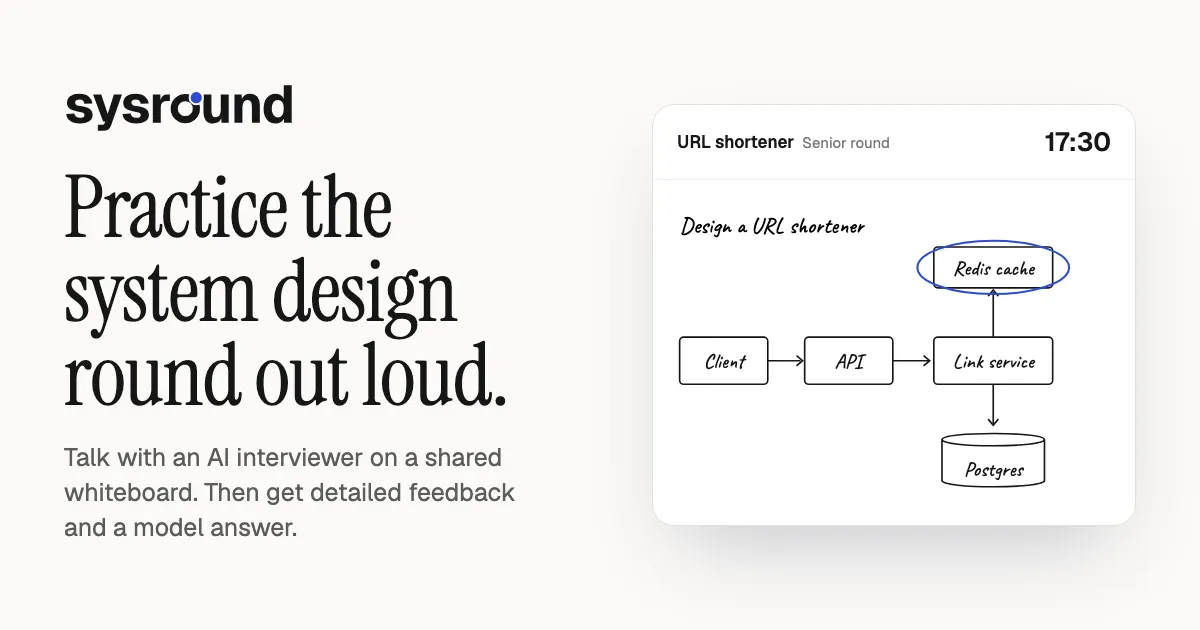
- Voice-based AI mock interviews for system design. An AI interviewer named Alex conducts 45 or 60 minute rounds with a shared whiteboard. Alex asks one question at a time, challenges design choices, reads diagrams, writes agreed numbers into notes and adds comments on parts that need follow-up. The site describes the interviewer as conversational rather than a chatbot that gives away answers.
- Seven-skill scorecards tied to interview level. After a mock interview, SysRound provides scores for problem framing and requirements, navigation and ownership, high-level architecture, technical depth, trade-offs and judgment, scale, reliability and operations, and communication and collaboration. Each score is compared with the bar for the selected level and quotes the candidate's own words or drawings.
- Structured feedback, model answers and practice plans. The scorecard includes important moments, better answers, a model answer built from the candidate's notes, a minute-by-minute whiteboard replay and a practice plan for weaker skills. The grader scores a round three times and uses the middle result, according to the site, to reduce noise in feedback.
How It Works
A candidate starts with a company search or a study plan. Company pages list reported questions with source context, while coding plans order problems into pattern groups. Opening a question loads the workspace, where code, notes, whiteboard and AI hints appear together. Coding practice involves writing a solution, checking examples and marking progress by group.
For an AI mock interview, the candidate selects a system design question, a level and a 45 or 60 minute format. Alex follows a timed structure from requirements and estimation through API design, high-level architecture, deep dives and wrap-up. The candidate speaks aloud, draws on the shared whiteboard and answers follow-up questions. At the end, the platform produces a scorecard, a model answer and a practice plan. The core library, company pages, coding plans and workspace are free. During the beta, two 45 minute mock rounds are included; afterward, rounds are sold in packs of 1 for $29, 5 for $99 or 12 for $199, with no subscription and no expiration. A progressive web app option supports phone-based review.
Use Cases
A candidate targeting Meta with six weeks of preparation can follow Coding Patterns 150, work through 18 pattern groups in order and track progress by group. The Meta company page lists 834 reported questions, giving the candidate a concrete pool for coding and system design review.
A senior engineer preparing for a Google system design round can run a 45 minute URL shortener mock with Alex. The sample scorecard shows a senior L5/E5 result with a 2 of 4 in scale, reliability and operations, highlighting a weaker area for follow-up. This fits candidates who need spoken practice and calibrated feedback rather than another written question bank.
A machine learning candidate aiming at OpenAI or Anthropic can use the 965 machine learning questions and the separate ML system design category. Company pages for OpenAI (642 questions) and Anthropic (444) add reported question context, while the free workspace supports notes and code for model, data, metrics and ML systems topics.
Who It's For
SysRound suits software engineers preparing for mid-level, senior or staff loops across coding, system design, machine learning or behavioral rounds. It is strongest for candidates who know the basics and need company-specific questions, spoken system design practice and level-calibrated feedback. The free library serves self-directed coding and ML preparation, while paid AI mock interviews focus on system design. Compared with standalone coding judges, SysRound adds company pages and interview simulation. AI mock coverage is limited to system design during the beta.
Pros & Cons
The Good
- Bundles 8,847 interview questions from 489 companies into searchable company and round-specific pages.
- Provides voice-based AI mock interviews with a shared whiteboard and a structured six-stage system design format.
- Scores seven interview skills against the selected level and quotes the candidate's own words or drawings.
- Offers free access to the question library, company pages, coding study plans and practice workspace.
- Uses a no-subscription pricing model with mock interview packs that do not expire.
The Bad
- AI mock interviews currently cover system design only, leaving coding, ML and behavioral rounds self-guided.
- After two beta rounds, mock interview practice requires paid packs with no unlimited or subscription option.
- The site notes that AI interviewer feedback can be wrong, so candidates need independent judgment when reviewing scores.