AI Web Maker
AI Web Maker is an AI website generator that builds and hosts a complete business site in minutes, with blog automation, a chatbot and lead capture included.
Overview
AI Web Maker is an AI website generator built by Finclock LLC that turns a plain-language description of a business into a complete, published website. Rather than treating site creation as an isolated task, the platform bundles hosting, automated blogging, social media scheduling, a customer-facing chatbot, email tools, contact forms and lead capture into one account. The pitch is aimed at owners who would otherwise juggle five or more subscriptions to reach the same result. The company states that the average time from signup to a live site is roughly five minutes and that every account ships with eight tools. The intended audience is small and mid-sized businesses: local retailers, consultants, restaurants, wellness practitioners, real estate agents, creative studios and early-stage e-commerce ventures. No coding or design background is required at any point in the workflow.
Key Features
- AI Website Builder. The core engine accepts a written brief covering what the business sells, who it serves and what differentiates it. From that input it generates pages, copy, imagery and layout, formatted for mobile devices and tuned to the industry described. The output is a site ready to publish rather than a set of templates that still need assembly.
- Blog Automation. The platform writes and publishes posts on a schedule defined by the account holder. Articles are produced with search-friendly headings and keywords relevant to the industry, and can be reviewed before publication or pushed live automatically, which removes the standing obstacle of finding time to write.
- Social Media Automation. Posts are created and queued for connected accounts, including Facebook, Instagram and LinkedIn, from the same dashboard used to manage the website. This consolidates scheduling that would otherwise require logging into each network separately.
- AI Chatbot Support. A chatbot is active on every generated site from day one, answering routine questions, capturing visitor details and forwarding complex enquiries by email. It operates continuously, and the vendor states that no manual training is needed to start, although further customization is possible.
- Web Hosting Included. Deployment happens on the vendor's own infrastructure, so no separate hosting account or DNS arrangement is required for a site to go live. The company describes the environment as fast and secure and states that hosting is not an add-on on any plan.
- Lead Capture and Contact Forms. Every site ships with customizable contact forms, and the chatbot feeds collected visitor information into a central contact system. Submissions are stored in the dashboard so follow-up does not depend on a personal inbox.
- Email Management. Welcome messages, follow-ups and promotional sends can be dispatched from the dashboard, allowing a contact list to be nurtured without a standalone email service provider.
- Free Standalone SEO Tools. A separate set of utilities that require no signup includes an SEO checker that scores public pages out of 100, a domain name finder that verifies availability, a company profile generator, a website launcher for unfinished projects and strategy generators for online marketing and social media.
How It Works
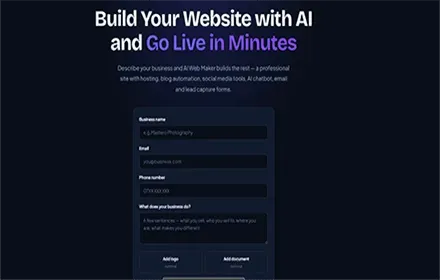
The process begins on the homepage with a single form. Prospective users supply a business name, an email address, a phone number and a free-text description of the business of up to roughly 4,000 characters. A logo and a supporting document such as a PDF or Word file can be attached, though both are marked optional and the build proceeds without them. A captcha guard sits in front of submission.
Once the form is sent, the generator produces the site in real time. According to the vendor, pages, written copy, images, contact forms, lead capture mechanics and the chatbot are all configured during generation, which is what enables the five-minute timeline. The next stage is review and publication. Publishing places the site on the included hosting, and the automation layer for blogging and social posting begins operating from that point. Businesses migrating from an existing site can redirect their domain to the new build, a switch the company describes as taking minutes rather than weeks. Pricing is not disclosed on the landing page, and registration is required to see plan details.
Use Cases
A restaurant owner could describe the menu, location and booking policy in a paragraph and receive a site with a contact form and chatbot, then take reservations through it without hiring a developer. A boutique fitness studio might lean on the chatbot to qualify enquiries outside opening hours, converting them into trial bookings that would otherwise be missed.
An independent consultant who needs steady search visibility but has no time to write can let blog automation publish weekly posts, keeping the domain active in search results. A logistics founder paying an agency retainer could rebuild with the bundled blog, email and social tools and cut the number of vendors involved.
A local retailer preparing for a seasonal campaign could use the social scheduler to push a month of posts from one queue while the site handles lead capture. Businesses with an abandoned domain or a stalled build could start with the website launcher, which preserves existing material and fills in what is missing. Marketing teams weighing channels could run the free strategy generator first and use its 90-day plan to decide whether a full build is warranted.
Who It's For
The product is aimed squarely at non-technical business owners: local shops, trades, restaurants, wellness practices, consultants, agents and small agencies. It is not positioned for engineering teams that need framework-level control, nor for large enterprises with existing content governance. Alternatives include Wix, Squarespace, Webflow, GoDaddy's builder and traditional agency engagements. Against template-based builders, AI Web Maker competes on speed and on the breadth of bundled tools rather than on design flexibility. Against agencies, it competes on cost and turnaround. The trade-off is a closed platform where customization depth is likely to be shallower than an open CMS, and where pricing has to be confirmed after registration.
Pros & Cons
The Good
- Combines website generation, hosting, blog automation, social scheduling, a chatbot, email and lead capture into a single subscription instead of several separate tools.
- Generates a complete, mobile-ready site from a short plain-language business description with no coding or design work required.
- Includes web hosting on every plan, so no separate hosting account or DNS configuration is needed to publish.
- Ships an always-on AI chatbot that answers routine questions and captures lead details from the first day without manual training.
- Offers a set of free, no-signup SEO and marketing utilities that let businesses test the platform's capabilities before subscribing.
The Bad
- Pricing is not published on the landing page, so plan costs, limits and term details require registration to confirm.
- The platform is fully closed with no open-source repository, which limits control over code, export options and long-term portability.
- Performance claims such as the five-minute build time and improved search rankings rest on vendor marketing and customer testimonials rather than independent testing.