Markloop
Markloop is a review platform for agent-made HTML documents, enabling human feedback loops that feed directly back into AI coding agents.
Overview
Markloop is a specialized web application designed to close the feedback loop between AI coding agents and human reviewers. As AI agents increasingly produce not just code but also documentation, specifications, reports, and proposals in HTML format, a new problem has emerged: how to collect structured human feedback on these artifacts and feed it back into the agent's workflow. Markloop addresses this gap by providing a dedicated environment where teams can share agent-generated HTML documents, collect comments and answers anchored to specific content, and export the feedback in a machine-readable format that agents can consume directly.
The product positions itself at the intersection of AI-assisted development and traditional document review. Unlike general-purpose tools like Google Docs or Notion, which are optimized for collaborative writing, Markloop is built specifically for the review stage of agent-generated content. It preserves the original HTML structure, including code blocks, diagrams, and formatting, which often degrade when pasted into other platforms. The platform supports versioning, anchored comments, and role-based access, making it suitable for both internal team reviews and client-facing deliverables.
Markloop integrates natively with Claude Code and Codex via the Model Context Protocol (MCP), allowing agents to push documents for review and pull feedback without leaving the terminal. For other agents, the feedback exports as plain files. The company emphasizes that no processing happens on its servers; agents apply changes locally, keeping control with the user. Reviewers are always free, and pricing is based on creator seats rather than the number of reviewers.
Key Features
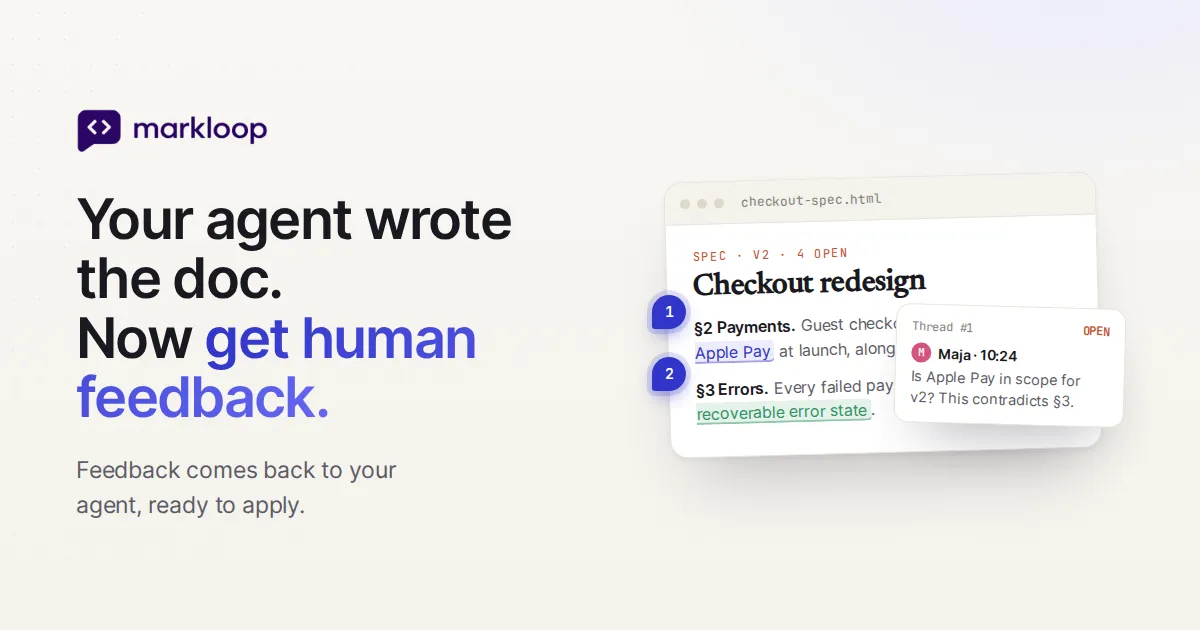
Anchored Comments – Comments in Markloop are pinned to specific elements or text passages within the HTML document. Unlike linear comment threads in word processors, these anchors remain attached to the exact content they reference, even as the document evolves through versions. This is particularly valuable for dense technical documents where a comment about a specific line or diagram needs to be unambiguous. The pin design mimics a droplet shape and appears inline, making it clear which content the comment refers to.
Agent-Ready Feedback Package – Every comment exports with structured metadata: the CSS selector targeting the element, the exact quoted text, the reviewer's note, the version context, and the comment status (open, addressed, or resolved). This package can be consumed by AI agents over MCP or as plain markdown files. The format is designed to minimize ambiguity, so agents can interpret the feedback and apply changes without human translation.
Versioning with Address Tracking – Each upload becomes a version in a chain. Comments are tied to the version they were made on, and new versions can mark comments as addressed or resolved. This creates a clear audit trail of what feedback has been handled and what remains open. The version history is visible within the project, and reviewers can see which version they are commenting on.
Unlimited Free Reviewers – Markloop does not charge per reviewer. Teams can invite clients, stakeholders, or colleagues as Viewers without incurring additional costs. Viewers can see the rendered document, leave comments, and answer embedded questions, but they cannot edit documents, access source files, or see other projects. This makes the platform suitable for client-facing reviews where the client should not have access to the raw HTML or other projects.
MCP Integration for Claude Code and Codex – Native MCP support allows agents to push documents to Markloop and pull feedback directly from the terminal. The integration is bidirectional: agents can upload new versions, retrieve open comments, and mark feedback as addressed. This eliminates the need to copy-paste between the agent and the review platform, streamlining the loop.
Read-Only Sharing with Access Controls – Beyond project-based collaboration, Markloop supports sharing individual files via read-only links. These links can be configured with expiry dates and version visibility controls. Links can be private (requiring authentication) or public. This is useful for sharing a single deliverable with a client who does not need project access.
Embedded Questions and Decisions – Reviewers can answer questions embedded directly in the document by the document author. These Q&A threads are treated as first-class feedback items, and the answers are included in the agent-ready package. This allows authors to proactively ask for specific input, such as confirming a design decision or clarifying a requirement.
How It Works
The Markloop workflow follows a five-step loop: Add, Share, Collect, Pull, Apply.
First, a user uploads an HTML document created by an AI agent. This can be done manually through the web interface or programmatically via MCP. The document becomes a version within a project, which acts as a container for related files, versions, comments, and reviewers.
Next, the user shares the document with reviewers. They can invite people to a project as Viewers, granting them access to all files within that project, or share a single file via a read-only link. Reviewers do not need an account to view shared links, though project Viewers must have a Markloop account (free for reviewers).
Reviewers then examine the document in its rendered HTML form. They can leave comments anchored to specific elements or text, and answer any questions the author has embedded. Comments are visible to all project members, and threads can be discussed in context.
Once feedback is collected, the author's AI agent pulls the feedback package over MCP or as a file download. The package includes all comments with their targets, quotes, and statuses. The agent can then apply changes locally, addressing each comment.
Finally, the agent publishes a new version back to Markloop, which marks addressed comments as resolved and carries forward any remaining open questions. The loop can repeat as needed.
Use Cases
Product Managers Reviewing AI-Generated Specs – A product manager uses an AI agent to draft a PRD. They upload the HTML to Markloop and invite engineering leads and stakeholders as Viewers. Reviewers comment on specific sections, such as the checkout flow or payment integration, and answer embedded questions about scope. The PM's agent then pulls the feedback and updates the spec, with changes tracked across versions.
Engineering Teams Reviewing Technical Design Docs – An engineer uses Claude Code to generate an RFC for a new architecture. They share the document with the team via Markloop. Team members comment on specific lines, such as the retry logic or idempotency key design. The agent pulls the feedback, applies changes, and publishes v2, with resolved comments marked accordingly.
Consultants Sharing Client Deliverables – A consultant generates a Q3 SEO audit report using an AI agent. They upload the HTML to Markloop and share a read-only link with the client. The client can view the polished report and leave comments on specific findings. The consultant's agent then incorporates the client's feedback into the final version.
Founders Looping Feedback on Investor Documents – A founder uses an AI agent to draft a market analysis document. They share it with advisors via Markloop, who comment on assumptions and data sources. The agent pulls the feedback, revises the document, and the founder shares the updated version with investors.
Anyone with an AI Agent – Any user who relies on an AI agent to produce HTML documents can use Markloop to collect human feedback. Whether it's a research report, a strategy document, or a technical plan, the platform provides a structured way to gather input and feed it back into the agent's workflow.
Pricing & Value
Markloop offers two paid plans: Solo at $19 per month (or $15 annually) and Team at $49 per month (or $39 annually). Both plans include a 14-day free trial with no credit card required. The Solo plan covers one creator seat with unlimited projects, documents, versions, and reviewers, plus MCP integration. The Team plan adds up to five creator seats, a shared workspace, team roles and permissions, removal of Markloop branding, and priority support.
Reviewers are always free on both plans, which is a significant differentiator from many collaboration tools that charge per user. The pricing is competitive for a niche tool, especially given the unlimited reviewer model. The annual discount of 20% provides an incentive for commitment. For early users, Markloop offers a "founding price" that is locked in, adding long-term value.
Compared to alternatives like Google Docs or Notion, Markloop's pricing is higher for a single user but offers specialized features that those tools lack, such as anchored comments tied to HTML elements and agent-ready export. For teams that regularly review agent-generated documents, the time saved by eliminating manual feedback translation can justify the cost.
Final Verdict
Markloop fills a genuine gap in the AI-assisted development workflow. As AI agents become more capable of producing complex documents, the need for a structured review process that bridges human and machine communication grows. Markloop's anchored comments, version tracking, and agent-ready export are well-designed for this purpose. The unlimited free reviewer model is a strong value proposition, especially for client-facing work.
However, the platform is narrowly focused. It only works with self-contained HTML files, not live websites or multi-page applications. Teams that need to review code changes or interactive prototypes will need other tools. Additionally, the reliance on MCP for agent integration means that users of less common agents may need to work with the plain file export, which is less seamless.
Markloop is best suited for teams and individuals who regularly produce HTML documents with AI agents and need a reliable way to collect and apply human feedback. It is less useful for teams that primarily work with markdown or other formats, or those who need real-time collaborative editing. For its target audience, Markloop offers a focused and effective solution.
For more details, check out their pricing or see how it works. You can also read the FAQ for common questions.
Pros & Cons
The Good
- Anchored comments stay attached to specific HTML elements and text, preserving context across versions.
- Agent-ready feedback package exports structured data with selectors, quotes, and statuses for direct consumption by AI agents.
- Unlimited free reviewers on all plans, making it cost-effective for client-facing reviews and large teams.
- Native MCP integration with Claude Code and Codex enables push and pull of documents without leaving the terminal.
- Version tracking with addressed/resolved status provides a clear audit trail of feedback implementation.
The Bad
- Only supports self-contained HTML files, not live websites, multi-page apps, or markdown documents.
- No real-time collaborative editing; reviewers can comment but cannot edit the document directly.
- Agent integration relies on MCP or manual file export, which may not work seamlessly with all AI agents.