Ellie
Ellie is a GLP-1 maintenance app that helps users keep weight off after stopping Ozempic, Wegovy, or Zepbound with a structured weekly plan.
Overview
Ellie enters the digital health market with a singular focus: helping people who have taken GLP-1 medications like Ozempic, Wegovy, Zepbound, and Mounjaro keep the weight off after they stop. While these drugs have revolutionized weight management, a growing body of research highlights a troubling pattern: two-thirds of lost weight returns within a year of discontinuation without a structured plan. Ellie addresses this gap by offering a week-by-week maintenance roadmap that adapts to whether a user is tapering, stretching doses, or already medication-free.
The app is built around the idea of a personal "line in the sand," a weight threshold the user chooses not to cross. Instead of rigid daily weigh-in targets, Ellie monitors the 7-day moving average and flags drift early, often at 4 pounds rather than 20. This proactive approach is backed by real-world clinic data showing that 45% of people who stop GLP-1s maintain or continue losing when given proper structure. Ellie's core proposition is that maintenance is not about willpower; it is about architecture.
The product also brings a substantial educational component. The website hosts five free calculators and 26 detailed guides covering everything from washout timelines and microdosing evidence to muscle preservation and food noise science. Every claim is graded, and sources are cited. This combination of an interactive app and a rich content library positions Ellie as a valuable resource for the growing number of patients navigating the post-GLP-1 period, a segment that traditional weight loss programs often neglect.
Key Features
The After Plan Timeline: Ellie's central feature is a week-by-week forecast that starts from the user's last dose or current tapering schedule. It anticipates the water-weight jump in week one, the return of appetite in weeks three to four, and the statistically dangerous months two to six when regain is most likely. Each phase comes with specific guidance, so users always know what to expect and how to respond. This is not a generic checklist; it is a dynamic plan that evolves based on the user's logging patterns and medication status.
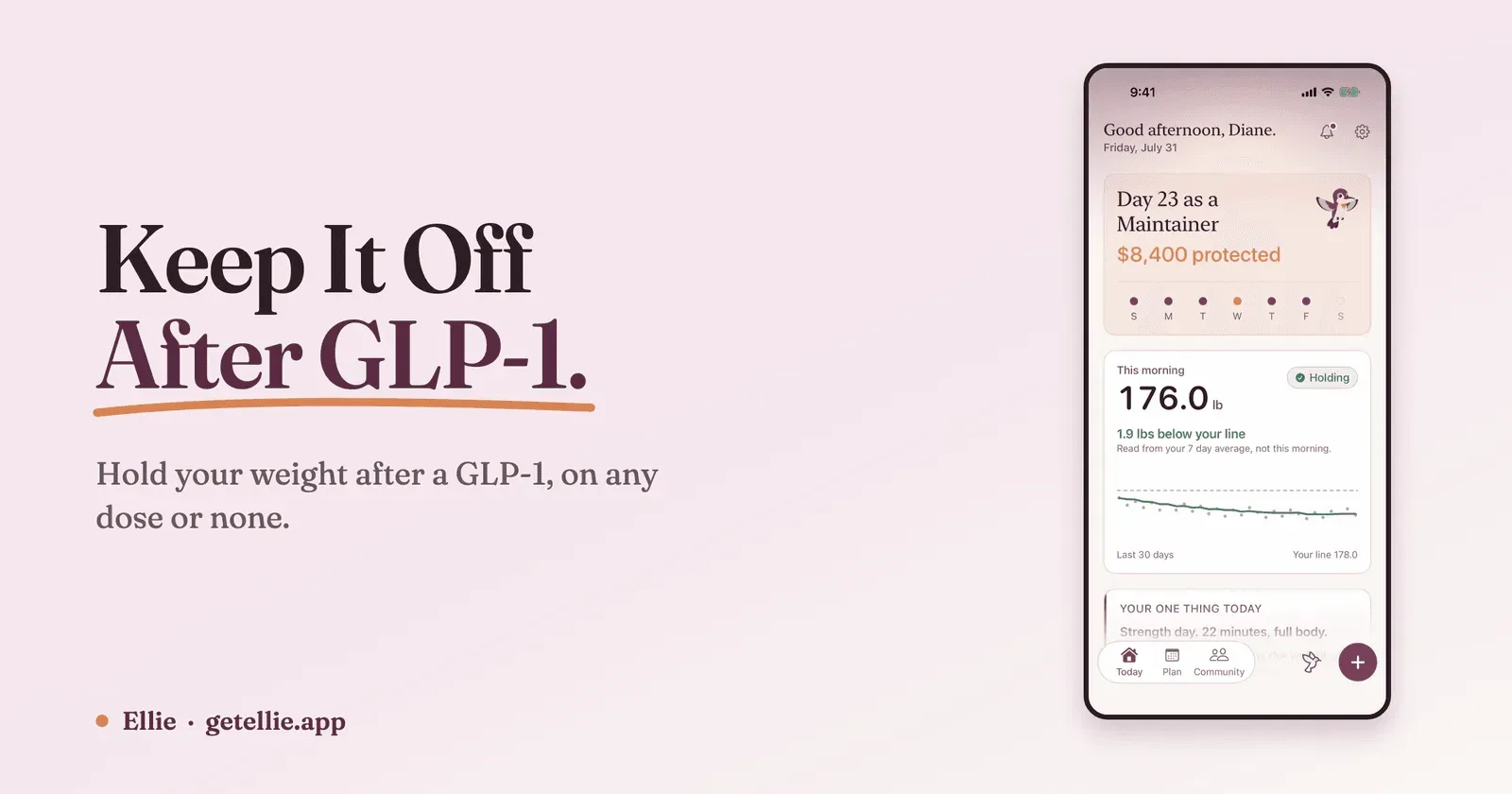
The Line You Will Not Cross: Instead of chasing a specific target weight, users define a boundary number. Ellie then tracks the 7-day trend to detect movement toward that line early. The app's interface shows a "4.6 lbs below your line" status, turning an abstract maintenance goal into a concrete, actionable metric. This approach reduces the anxiety of daily weigh-ins while still catching meaningful shifts. The system deliberately ignores single-day fluctuations, which are often water or glycogen, and focuses on the slope of the trend line.
Food Noise SOS: One of the most innovative features is a panic button for moments when food thoughts become overwhelming. Selecting "a craving," "can't stop thinking about food," or "about to binge" triggers a 10-minute protocol designed to interrupt the pattern. The app also charts the user's food noise trend over weeks, showing measurable decline and reinforcing that the episodes do fade. This feature is particularly valuable for the psychological battle that follows stopping a GLP-1, as the sudden return of food chatter can be demoralizing.
Protein and Strength Floor: To protect lean mass during a calorie deficit, Ellie sets daily protein targets and suggests brief 20-minute strength sessions. These are framed as a "floor," not a ceiling, emphasizing consistency over intensity. The design avoids cardio guilt and focuses on the two levers that evidence shows matter most for maintaining composition. Users are not directed to extreme workouts; instead, the app encourages short, manageable sessions that can fit into a busy schedule, aligning with the reality of long-term maintenance.
Bring-to-Prescriber Export: A one-page summary can be generated that includes the user's actual medication regimen, weight trend, and maintenance plan. This feature is designed to facilitate more productive conversations with doctors, especially around dosing decisions. Ellie deliberately never suggests doses; it simply records what the user and their clinician have decided. The export is clean, data-rich, and avoids medical jargon, making it accessible for both patients and providers. It also subtly encourages accountability, as users know their prescriber may see the data.
Medication Status Modeling: The app recognizes that "coming off" is not a single event. Users can indicate whether they are on a standard weekly dose, a stretched schedule, a step-down taper, or completely off. Ellie adjusts its predictions and recommendations accordingly, making the plan relevant to a variety of real-world scenarios. For example, someone stretching doses every 10 days will see a different timeline than someone who stopped cold turkey. This granularity is a key differentiator from generic weight loss apps that treat all users the same.
Free Tools and Guide Library: Beyond the app, the website offers a washout calculator, a microdosing chart, a taper schedule visualizer, maintenance calorie calculator, and a protein calculator. The 26 guides cover topics like "What Happens When You Stop," "How to Not Gain It Back," and "The Food Noise Came Back," each with cited research. For more in-depth reading, the guide library provides a wealth of evidence-backed advice, making it a valuable reference even for those who do not download the app.
How It Works
The first step is downloading the free app from the App Store. After a quick onboarding, the user sets their boundary line, typically a weight they are comfortable measuring against. They then indicate their medication status: still taking a standard dose, stretching, tapering, or already stopped. This initial input shapes the entire plan, ensuring that the advice is relevant to their specific situation.
Daily use is intentionally lightweight. The user logs their morning weight, and Ellie updates the 7-day trend. If the trend moves more than a small amount from the previous week, the app may suggest a "tighten week," with adjustments to protein targets or strength sessions. There are no red numbers or punishment; instead, the tone is neutral and data-driven. This abstemious approach reduces the emotional weight of daily logging, which is often the reason people abandon habit trackers.
When a craving or food noise episode hits, the user can open the Food Noise SOS. The tool walks through a brief check-in and provides a specific protocol tailored to the intensity. Over time, the app aggregates these episodes into a trend chart, helping users see that the noise is, in fact, diminishing. This visual feedback is a powerful motivator, as it quantifies an experience that often feels endless.
For those still on medication, Ellie logs the regimen details and builds a timeline for a planned taper. When the user is ready to share their progress with a prescriber, they can export the one-page summary and bring it to their appointment. This closes the loop between the app and the clinical team, bridging a gap that few digital health products address. The entire workflow is designed to be as frictionless as possible, with the understanding that consistency is king.
Use Cases
A patient who has just finished their last box of Ozempic and wants to avoid the typical rebound. Ellie's week-by-week plan predicts the water-weight jump and the appetite surge, providing preemptive strategies like locking in a protein floor and scheduling strength days. The user sees the timeline on day one and feels prepared rather than caught off guard.
A person tapering off Wegovy with their doctor, injecting a lower dose every 10 days instead of 7. Ellie's medication modeling adjusts the expected timeline and offers guidance for the stretched schedule, reducing the guesswork. This user can also export the plan to show their prescriber, fostering a collaborative approach to dose reduction.
Someone on maintenance who has successfully held their weight for six months but wants to extend the time between doses. The app tracks the 7-day trend and provides reassurance that a slower taper is safe, while the prescriber export gives the doctor the data needed to approve the plan. This use case highlights Ellie's utility for long-term users, not just those in the immediate aftermath of stopping.
A user who relapses into food noise after stopping Mounjaro finds the SOS tool is a reliable first defense. The 10-minute protocol often short-circuits a binge episode, and the trend chart shows that the frequency of episodes is dropping over consecutive weeks. The user reports that the tool gives them a moment of pause, transforming a familiar spiral into a manageable, time-boxed challenge.
A person who has already regained a few pounds after stopping Zepbound and wants to catch it now, not later. The line-based trend system flags the drift at 4 pounds, triggering a "tighten week" with specific adjustments to daily protein and strength work, preventing a 20-pound regain. This proactive intervention is exactly the kind of early feedback loop that long-term maintenance studies recommend.
Pricing & Value
Ellie is free to download, with a subscription unlocking the full plan. The website does not list exact pricing, but the app follows a freemium model where the free version includes the daily log, trend line, and access to the companion website's tools. The subscription provides the complete After Plan timeline, Food Noise SOS, and the prescriber export.
Given that the cost of a single session with a dietitian or weight loss coach often exceeds a monthly app fee, Ellie's structured plan likely represents strong value, especially for the prevention of weight regain, which has its own long-term health costs. The free tools and guides alone outperform many paid content libraries. However, the lack of transparent pricing on the website may discourage price-sensitive users from exploring the subscription. A clear pricing page would reduce friction and allow prospective users to make an informed decision without downloading the app first.
Final Verdict
Ellie solves a real problem that most weight loss apps ignore: what happens after the medication ends. Its emphasis on structure, early drift detection, and honest communication with prescribers sets it apart from generic habit trackers. The 7-day trend line and the "line you will not cross" concept are genuinely clever, moving the focus from daily fluctuations to meaningful patterns.
The main limitations are platform availability and cost. An iPhone-only launch excludes a substantial portion of the potential market, and the subscription fee adds to the already expensive burden of GLP-1 treatment. Additionally, the lack of integrations with smart scales and health platforms means manual logging is the only option. For anyone committed to maintaining their results after a GLP-1 journey, Ellie is a well-designed, evidence-aware companion worth downloading on iOS. To learn more about the product's mission, visit the about page.
Pros & Cons
The Good
- The week-by-week After Plan anticipates specific challenges like water-weight spikes and appetite return, so users are never surprised.
- The 'line you will not cross' approach uses 7-day trends instead of daily weigh-ins, enabling earlier and more nuanced drift detection.
- The Food Noise SOS offers an immediate, guided protocol for managing cravings, paired with long-term noise trend tracking.
- The free tools on the website, including a washout calculator and microdosing chart, provide substantial value without requiring app signup.
- The prescriber export feature creates a clean, data-rich summary that facilitates more informed conversations between patients and clinicians.
The Bad
- The app is currently iPhone-only, with Android support still listed as 'next,' which narrows its potential user base.
- The full plan requires a paid subscription, which may be a hurdle for those already paying for GLP-1 prescriptions.
- There is no integration with smart scales, Apple Health, or other fitness trackers, meaning all weight logging must be done manually.