AnyAPI
AnyAPI unifies 1,200+ scraping and data APIs behind one key with pay-per-request pricing, eliminating subscriptions and simplifying integration.
Overview
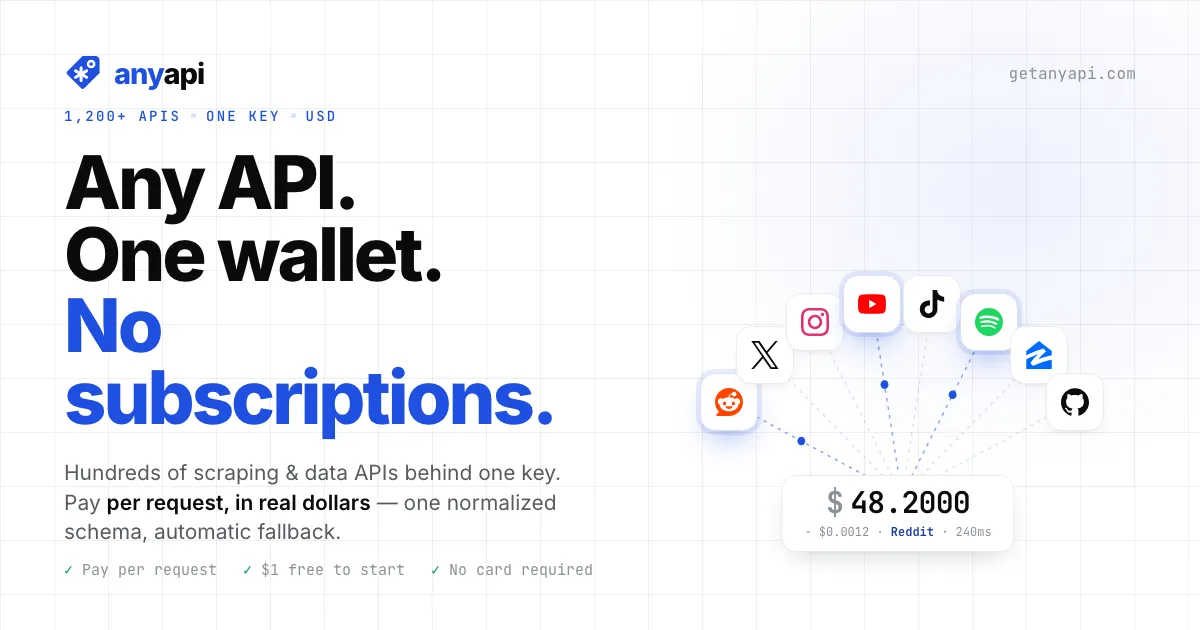
AnyAPI is a unified API platform that aggregates over 1,200 scraping and data APIs from various providers into a single interface. The product addresses a common pain point for developers and businesses: managing multiple API subscriptions, each with its own billing cycle, key, and schema. Instead of juggling separate plans for Twitter, Instagram, LinkedIn, TikTok, and dozens of other services, AnyAPI offers one wallet, one key, and pay-per-request pricing in real dollars. The platform is designed for data extraction, lead generation, brand monitoring, competitor research, and other use cases that require access to structured data from social media, e-commerce, search engines, and other web sources.
AnyAPI positions itself as a cost-effective alternative to traditional API marketplaces and direct subscriptions. The core value proposition is that users only pay for what they use, with no monthly minimums or idle costs. The platform also provides automatic fallback routing: if a primary provider fails, requests are rerouted to alternative providers with the same schema, ensuring reliability without code changes. The service is particularly appealing to AI agents and automation workflows, as it offers an MCP (Model Context Protocol) server that allows agents to discover and call APIs autonomously.
The market for API aggregation is competitive, with players like RapidAPI and various scraping service marketplaces. However, AnyAPI differentiates itself by focusing on pay-per-request pricing in real dollars (not credits), a normalized schema across providers, and built-in fallback routing. The platform also offers a free $1 wallet to start, with no credit card required, lowering the barrier to entry.
Key Features
Unified API Catalog: AnyAPI provides access to over 1,200 APIs covering social media platforms (Reddit, TikTok, Twitter/X, Instagram, YouTube, LinkedIn, Facebook, Threads, Pinterest, Snapchat, Twitch, Bluesky), e-commerce sites (Amazon, eBay, Walmart, Etsy, AliExpress, Shopify), real estate (Zillow, Airbnb, Booking.com, Tripadvisor), job boards (Indeed, Glassdoor, Upwork), review platforms (Yelp, Trustpilot), business data (Crunchbase), app stores (App Store, Google Play), search engines (Google Search), and music services (Spotify, SoundCloud). Each API is documented with endpoints, pricing per request, and provider options.
Pay-Per-Request Pricing: Instead of monthly subscriptions, AnyAPI charges per API call in US dollars. Prices vary by endpoint, typically ranging from $0.0008 to $0.0050 per request. Users top up a single wallet and draw down from it as they make calls. There are no monthly fees, no minimum commitments, and idle accounts incur no charges. The wallet balance is displayed in real dollars, not proprietary credits.
Automatic Provider Fallback: For each API endpoint, AnyAPI aggregates multiple underlying providers. If the primary provider returns an error or times out, the platform automatically retries the request with the next provider in the fallback chain. All providers return the same normalized schema, so the client code never needs to change. Users can configure the fallback order or pin a preferred provider.
Provider Comparison and Routing: The platform ranks providers by price, latency, and uptime, allowing users to compare and choose the best option for their needs. A visual routing interface shows the current primary provider and fallback order. Users can click to change the primary provider, and the system will route requests accordingly.
MCP Server for AI Agents: AnyAPI exposes an MCP (Model Context Protocol) server at https://api.getanyapi.com/mcp. This allows AI agents like Claude Code or Cursor to connect and use four tools: list_apis (search the catalog), get_api (get schema and pricing), run_api (execute a call), and get_balance (check wallet). Discovery calls are free, so agents can browse schemas without incurring costs.
Schema Normalization: Across different providers for the same endpoint, AnyAPI normalizes the response schema. For example, a TikTok profile endpoint returns the same JSON structure regardless of which underlying provider is used. This eliminates the need to rewrite integration code when switching providers.
Free $1 Wallet to Start: New users receive a $1 credit in their wallet upon signup, with no credit card required. This allows them to test the platform and make real API calls before committing financially.
How It Works
Getting started with AnyAPI involves a straightforward process. First, users sign up on the dashboard and receive a free $1 wallet. No credit card is required at this stage. Once signed in, users can generate an API key from the dashboard.
With the API key, users can browse the catalog to find the desired endpoint. The catalog is organized by platform and use case, with each endpoint showing the available providers, pricing per request, and documentation. Users can also use the search functionality to find specific APIs.
To make a call, users send a GET or POST request to the AnyAPI endpoint URL, including the API key in the Authorization header. For example, to search Google, the request would be GET /v1/search?engine=google&q=query. The platform routes the request to the primary provider, and if that fails, it falls back to the next provider in the chain. The response is returned in a normalized format.
For AI agents, the process is even simpler. Agents connect to the MCP server using their API key, and then they can use natural language to discover and call APIs. For instance, an agent can ask "How many monthly listeners does Bad Bunny have?" and the agent will automatically call the Spotify artist endpoint and return the result.
Users can monitor their usage and wallet balance in the dashboard. They can top up the wallet at any time via Stripe integration. There are no recurring charges, so if a user stops making calls, the wallet balance remains until used.
Use Cases
Lead Generation from Social Media: A sales team can use AnyAPI to scrape LinkedIn profiles and posts to identify potential leads. For example, they can search for posts mentioning "looking for a CRM" and extract the author's profile information. With pay-per-request pricing, they can run targeted searches without committing to a monthly LinkedIn API subscription.
Competitor Price Monitoring: An e-commerce business can monitor competitor prices on Amazon, Walmart, and eBay. They can set up automated scripts to check prices daily for specific products. AnyAPI's fallback routing ensures that if one provider is down, the script still gets data from another provider without failing.
Brand Sentiment Analysis: A marketing agency can track mentions of their client's brand across Reddit, Twitter, and YouTube. They can use AnyAPI to search for keywords and collect posts, comments, and videos. The unified schema makes it easy to aggregate data from multiple platforms into a single analysis pipeline.
Influencer Discovery: A brand looking for influencers can use AnyAPI to search for TikTok and Instagram profiles with high engagement rates. They can filter by follower count, location, and niche. The pay-per-request model allows them to explore many profiles without a large upfront cost.
AI Agent Automation: A developer building an AI agent can integrate AnyAPI via MCP to give the agent access to real-time data. For example, an agent that helps users research products can call Amazon and eBay APIs to compare prices and reviews, then present the results in a structured format.
Pricing & Value
AnyAPI's pricing is straightforward: users pay per request in US dollars. There are no subscription tiers, no monthly fees, and no minimum commitments. Each endpoint has a fixed price per request, typically ranging from $0.0008 to $0.0050. For example, a Reddit search costs $0.0012 per request, while a Google Search costs $0.0050 per request. Users can see exact prices in the catalog.
New users receive a $1 credit upon signup, which is enough to make hundreds of calls on cheaper endpoints. To continue using the service, users top up their wallet via Stripe. There is no minimum top-up amount, but typical top-ups are in the range of $5 to $50.
Compared to traditional API subscriptions, which can cost $49 to $199 per month per platform, AnyAPI offers significant savings for low-to-medium volume users. For example, a user who makes 1,000 Google Search calls per month would pay $5.00 on AnyAPI, versus $49+ for a dedicated subscription. However, for very high-volume users, the per-request cost may add up, and a dedicated subscription might be more economical. AnyAPI does not offer volume discounts, which is a trade-off.
The value proposition is strongest for users who need access to multiple APIs but use each one sporadically. The ability to pay only for what is used, with no idle costs, makes it ideal for startups, side projects, and AI agents.
Final Verdict
AnyAPI is a well-designed solution for developers and businesses that need flexible, pay-as-you-go access to a wide range of data APIs. Its unified catalog, normalized schemas, and automatic fallback routing reduce integration complexity and operational overhead. The pay-per-request pricing model is refreshingly transparent compared to the opaque credit systems used by many competitors.
The platform's MCP server integration is a forward-thinking feature that positions it well for the growing AI agent ecosystem. The free $1 wallet lowers the barrier to entry, allowing users to test the service risk-free.
However, there are limitations. The per-request pricing can become expensive for high-volume use cases, and the lack of volume discounts may deter heavy users. The catalog, while extensive, may not cover every niche API, and some users may find that certain endpoints have limited provider options. Additionally, the platform is relatively new, so the provider network and reliability are still being proven.
Overall, AnyAPI is an excellent choice for developers, startups, and AI agents that need affordable, flexible access to multiple data sources without the burden of multiple subscriptions. For more details, check out their pricing or browse the catalog. Developers can also read the documentation to get started quickly.
Pros & Cons
The Good
- Unified access to over 1,200 APIs from a single key and wallet, eliminating the need for multiple subscriptions.
- Pay-per-request pricing in real dollars with no monthly fees, no minimums, and no idle costs.
- Automatic fallback routing across multiple providers with normalized schemas, ensuring reliability without code changes.
- MCP server integration allows AI agents to discover and call APIs autonomously using natural language.
- Free $1 wallet on signup with no credit card required, enabling risk-free testing of the platform.
The Bad
- Per-request pricing can become expensive for high-volume use cases compared to dedicated subscriptions with volume discounts.
- The catalog, while extensive, may not cover every niche API, and some endpoints have limited provider options.
- As a relatively new platform, the provider network and long-term reliability are still being established.