CiteTrue
Citation checker CiteTrue verifies references against 18+ academic databases, flagging fake or AI-generated citations before reviewers spot them.
Overview
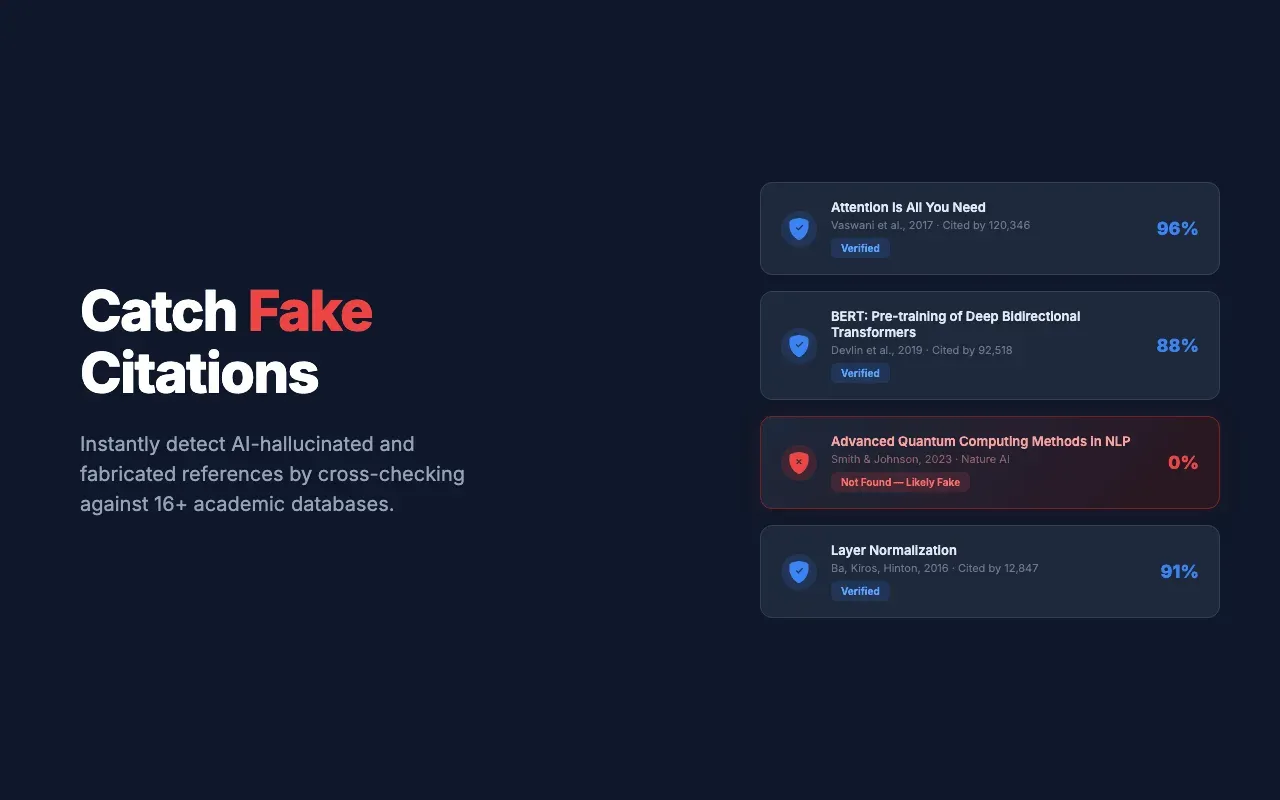
CiteTrue is a free citation verification service for academic writing. It accepts a pasted reference list in almost any format, splits each entry into its component fields, and queries scholarly databases to confirm that the cited work exists and that the attached details match. Instead of returning a simple found-or-missing verdict, the platform produces a per-reference confidence score and flags entries that appear fabricated, mangled, or machine generated. It is delivered as a web application alongside a Chrome extension and a native Mac client.
Key Features
- Field-level reference matching. Citations are decomposed into title, authors, year, DOI, venue, volume, and pages, and each field is compared separately with the matched database record. This catches entries that point at a real paper while crediting the wrong authors or reporting the wrong year.
- Cross-referencing across more than eighteen scholarly sources. Verification draws on arXiv, CORE, Crossref, Google Scholar, OpenAlex, ResearchGate, Semantic Scholar, PubMed, ScienceDirect, IEEE, ACM, Springer, Wiley, Elsevier, BMC, Cambridge University Press, and OpenLibrary, with additional paid data sources layered in.
- Bulk verification with confidence scores. Dozens or hundreds of references can be submitted in a single pass, each returning a score that estimates how likely it is to be genuine and accurate.
- AI-hallucination detection. The system is tuned specifically for references produced by large language models and is documented on the site with three peer-reviewed studies on fabricated citations.
- Fast Verify and Deep Verify modes. Fast Verify processes standard numbered or bulleted lists at one credit per reference, while Deep Verify costs five credits per reference and handles text structures that defeat automatic parsing.
- Automatic format normalization. Input citations are reformatted during the check, so a roughly pasted reference list does not need to be cleaned up beforehand.
- Credit-based access with referral bonuses. Checking runs on a credit system with a free daily allowance, and an invite-a-friend program grants bonus credits to both parties.
- Multilingual interface and companion apps. The product is localized in eleven languages and extends to a Chrome extension, a Mac application, and API plus MCP documentation for programmatic use.
How It Works
A user pastes a reference list or in-text citations into the checker. The service identifies the input type, splits the text into individual references, and queues each entry for matching. Retrieval algorithms query the connected databases, and a scoring model compares returned records field by field before assigning a confidence percentage. Results separate verified references from mismatches and unfound entries, and a full report can be generated. When the structure is too irregular for automatic parsing, the interface suggests Deep Verify or reformatting as a standard numbered list.
Who It's For
The tool targets four overlapping groups. Students and doctoral candidates check references before submission to reduce retraction and misconduct risk. Advisors and professors screen student work with it before grading or endorsement. Journal editors and peer reviewers apply it during intake screening to filter fabricated references out of the submission pile. Independent researchers use it to confirm that sources cited in other papers actually exist before building on them. The vendor claims more than 30,000 students and researchers as users, and the free daily quota keeps casual checking viable without a paid plan.
Evidence and Adoption
CiteTrue leans on three peer-reviewed findings in its own documentation: Walters and Wilder's 2023 Scientific Reports study reporting that 55 percent of GPT-3.5 citations and 18 percent of GPT-4 citations were fabricated; a Cureus paper finding an average of 4.3 incorrect components per reference across 30 ChatGPT-generated medical papers; and Nature's report of more than 10,000 retractions in 2023. The workflow is free to try but not unlimited. Bulk checking runs on credits, the deeper verification mode consumes five per reference, and auditing a dissertation-length bibliography will exhaust a free allowance quickly. The scoring methodology behind the confidence percentages is not published, so the tool is best treated as a first-pass filter that still requires human judgment on borderline results.
Pros & Cons
The Good
- Verifies each reference field separately, catching citations that point at a real paper but carry wrong authors, years, or DOIs.
- Cross-references more than eighteen academic databases, including PubMed, IEEE, Crossref, Springer, and Semantic Scholar.
- Detects AI-hallucinated references and supports the problem statement with three peer-reviewed studies cited on the site.
- Bulk processing handles dozens or hundreds of references in one pass and returns a per-reference confidence score.
- Localized in eleven languages with a Chrome extension, a Mac app, and published API and MCP documentation.
The Bad
- Deep Verify consumes five credits per reference, so a dissertation-length bibliography drains the free daily allowance quickly.
- The confidence scoring model is proprietary and no methodology is published, leaving results difficult to audit independently.
- Fast Verify struggles with irregular text structures and must fall back to reformatting or the more expensive verification mode.