PlumberCalc
Professional plumbing calculators for pipe sizing, flow rate, pressure drop, and water heater sizing. Free tools for plumbers and engineers.
Overview
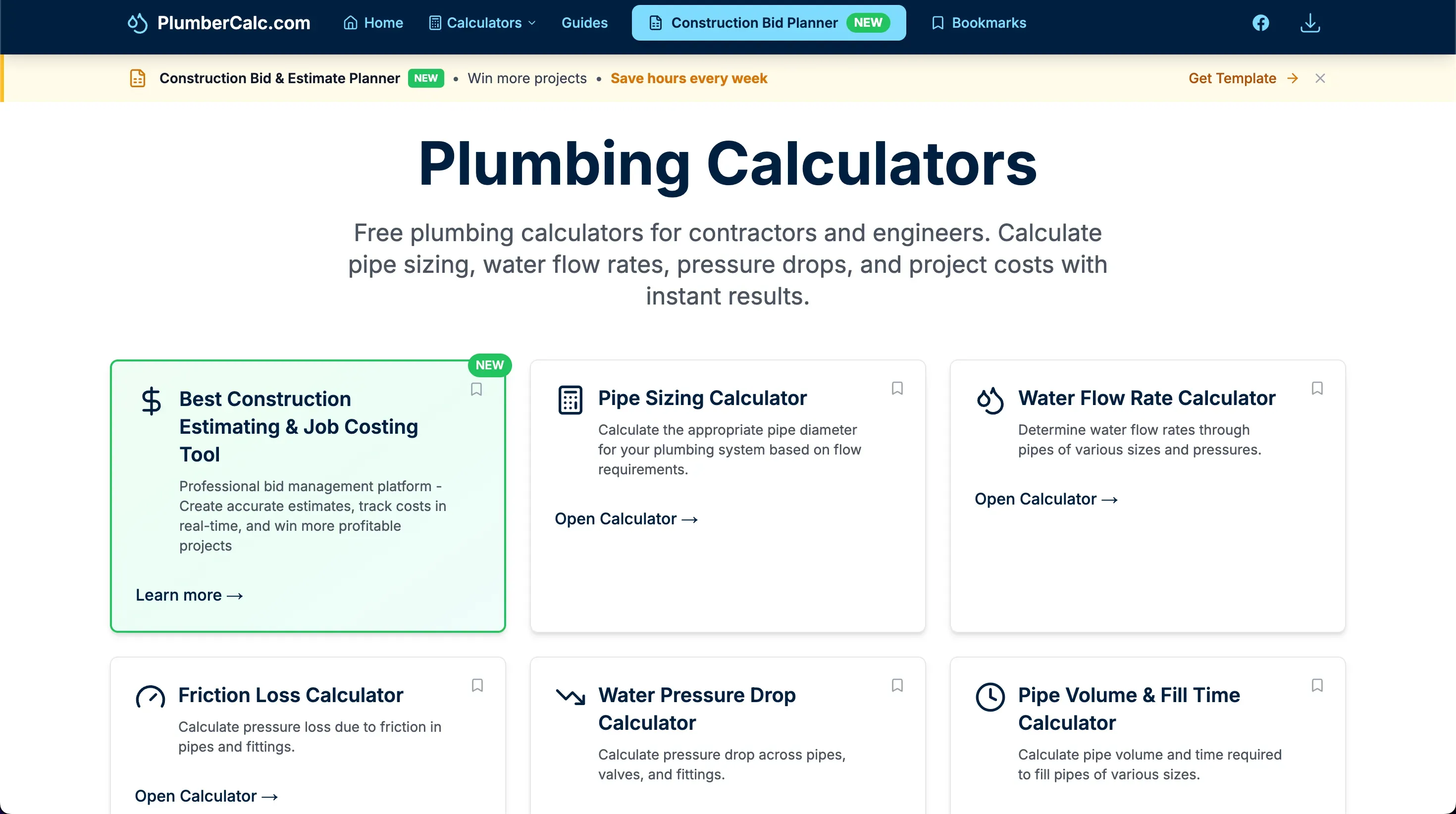
PlumberCalc is a free online suite of professional plumbing calculators designed for contractors, engineers, and DIY enthusiasts. The platform addresses the core problem of accurate and quick plumbing calculations, eliminating manual errors and saving time on job sites. With tools for pipe sizing, water flow rate, pressure drop, friction loss, and water heater sizing, PlumberCalc covers the essential needs of plumbing system design. The calculators are built on industry-standard formulas like Hazen-Williams, Manning's, and Darcy-Weisbach, ensuring results that align with IPC and ASME standards. The site is fully responsive, works offline once loaded, and is completely free to use, making it a go-to resource for professionals who need reliable calculations on the go.
Key Features
- Pipe Size Calculator: Enter required flow rate (GPM), pipe length, and material to instantly get recommended pipe diameter, velocity, and pressure drop. Supports copper, PEX, PVC, steel, and other common materials with automatic friction factor application.
- Water Flow Rate Calculator: Calculates flow rate based on pipe diameter, velocity, or pressure. Uses the continuity equation (Q = A × V) and Hazen-Williams formula for accurate results.
- Pressure Drop Calculator: Computes friction loss using Darcy-Weisbach equation (hf = f(L/D)(V²/2g)) and minor losses via K-factor calculations. Essential for pump sizing and system design.
- Water Heater Sizing Calculator: Determines appropriate water heater size based on household demand, recovery rate, and first-hour rating. Includes tankless water heater flow rate calculator.
- Gas Line Sizing Calculator: Handles both natural gas and propane calculations. Enter BTU requirements and pipe length to get proper gas line sizing that meets safety standards.
- Drain Slope Calculator: Calculates required slope for drainage pipes using Manning's formula for open channel flow. Ensures proper drainage and code compliance.
- Plumbing Cost Estimator: Provides material and labor cost estimates for common plumbing projects. Helps contractors create accurate bids.
- Construction Bid Planner: A dedicated tool for contractors to plan and estimate project bids, with a template to win more projects and save hours weekly.
- Offline Functionality: All calculators work offline after initial page load, perfect for job sites with poor internet. The site can be added to a phone's home screen for instant access.
- Mobile Responsive Design: The interface adapts seamlessly to phones, tablets, and desktops, ensuring usability in the field.
How It Works
Users land on the homepage and navigate to any calculator via the top menu or the "Calculators" dropdown. Each calculator presents a clean form with input fields specific to the calculation type. For example, the Pipe Size Calculator asks for flow rate (GPM), pipe length, and material selection. As users enter values, results update in real time, showing recommended pipe diameter, velocity, and pressure drop. The interface is intuitive, with clear labels and unit conversions handled automatically. No signup or account is required; all tools are free and accessible immediately. The site also includes a bookmark feature to save favorite calculators for quick access. For offline use, users simply load the page once while online, and subsequent visits work without an internet connection.
Use Cases
- A plumbing contractor sizing pipes for a new residential building: The contractor uses the Pipe Size Calculator to determine the correct diameter for copper water lines based on fixture units and pipe length, ensuring adequate flow and pressure while meeting local code.
- An engineer designing a commercial drainage system: Using the Drain Slope Calculator with Manning's formula, the engineer calculates the required slope for PVC pipes to handle stormwater runoff, preventing flooding and ensuring compliance with IPC standards.
- A homeowner replacing a water heater: The Water Heater Sizing Calculator helps the homeowner choose the right tank size based on household occupancy and peak demand, avoiding undersizing or oversizing.
- A gas fitter installing a natural gas line for a restaurant kitchen: The Gas Line Sizing Calculator determines the proper pipe diameter for a given BTU load and run length, ensuring safe and efficient gas delivery.
- A project manager preparing a bid for a plumbing renovation: The Construction Bid Planner provides a template to estimate labor, materials, and overhead, helping the manager submit a competitive and accurate proposal.
Who It's For
PlumberCalc is built for plumbing professionals, including contractors, engineers, and technicians, as well as DIY homeowners. It serves small to medium-sized businesses and individual tradespeople who need reliable, on-the-go calculations without expensive software. Compared to alternatives like the Plumbing Code app or manual lookup tables, PlumberCalc offers instant results, a broader range of calculators, and offline access. Its free pricing model makes it accessible to anyone, while the use of standard engineering formulas ensures professional-grade accuracy. The site also provides how-to guides for common tasks, making it a comprehensive resource for both novices and experts.
Pros & Cons
The Good
- All calculators are completely free to use with no signup required.
- Calculators work offline after initial page load, ideal for job sites with poor connectivity.
- Uses industry-standard formulas like Hazen-Williams and Darcy-Weisbach for professional accuracy.
- Mobile responsive design ensures usability on phones and tablets in the field.
- Includes a Construction Bid Planner tool to help contractors win more projects.
The Bad
- Limited to plumbing calculations; does not cover electrical or HVAC beyond a unit converter.
- No user accounts or saved history; results cannot be stored or retrieved later.
- Disclaimer states results are estimates and should be verified with local codes, which may reduce trust for critical applications.