freispace
KI-fähige Postproduktions-Planungsplattform für Studios, die Workflows optimiert und Produktivität steigert.
Overview
freispace is a German-built, AI-native planning platform designed specifically for post-production studios and media production houses. The platform addresses a critical gap in the market: legacy scheduling tools that lack the flexibility to integrate modern AI workflows. As the media industry accelerates toward AI adoption, with 25% of studios prioritizing AI implementation in 2025 according to The Big Broadcast Tech Survey, freispace positions itself as a future-proof solution. The platform combines resource management, project planning, task tracking, budgeting, invoicing, and CO2 emissions tracking into a single system, all built from the ground up with AI collaboration in mind. Unlike competitors that retrofit AI onto older architectures, freispace offers native features like a self-hosted AI chat assistant (orgAI), MCP server technology for enterprise AI integration, and open APIs for workflow automation. The company claims McKinsey research shows 40% productivity gains through AI adoption, and the platform is designed to capture those gains for post-production teams.
Key Features
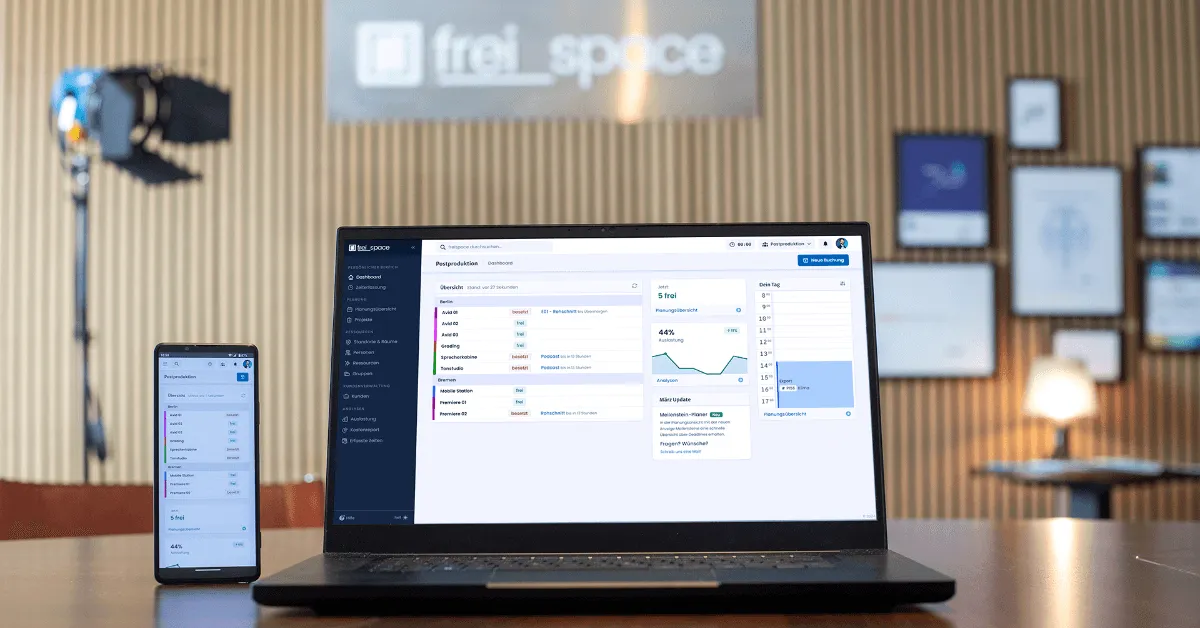
Resource Management – The platform provides real-time visibility into editing suites, studios, personnel, and software licenses. Users can assign resources with drag-and-drop simplicity, track utilization rates, and avoid double bookings. The system supports complex scheduling dependencies common in post-production, such as color grading suites needed after editing is complete.
Project Planning with Gantt Charts – freispace offers Gantt-style project timelines with phases, milestones, and task dependencies. This visual approach helps producers map out entire post-production workflows, from rough cuts to final delivery. The timeline automatically adjusts when tasks shift, keeping schedules accurate.
Task and To-Do Management – Teams can create, assign, and track tasks with deadlines and priority levels. The task view integrates with the project timeline, so every to-do is linked to a specific phase or milestone. Notifications keep everyone informed of changes.
Budget and Cost Control – The platform includes comprehensive budgeting tools that track actual spending against planned costs. Users can monitor project profitability, view cost breakdowns by department or resource, and generate reports for stakeholders. This feature helps studios avoid budget overruns.
Invoicing and Quoting – freispace includes an integrated invoicing module that supports GoBD-compliant e-invoicing. Users can generate quotes, convert them to invoices, and track payment status. The system handles recurring billing and payment reminders.
CO2 Emissions Tracking – A unique feature for post-production, the platform automatically calculates CO2e emissions based on resource usage, energy consumption, and travel. This helps studios meet ESG reporting requirements and demonstrate sustainability commitments.
AI Integration (orgAI) – The standout feature is orgAI, a self-hosted AI assistant that provides natural language access to project data. Users can ask questions like "What tasks are overdue?" or "Show me next week's schedule" without navigating menus. The AI respects user permissions and never shares data externally. Additionally, the MCP server enables enterprise AI systems to connect directly to freispace data.
How It Works
New users start by creating a studio profile and inviting team members. The onboarding wizard guides through setting up resources: editing suites, color grading rooms, audio studios, and personnel with their skills and availability. Once resources are defined, users create projects with start and end dates, then break them down into phases (e.g., offline edit, online edit, color grading, sound mix). Each phase can have multiple tasks assigned to specific team members. The Gantt chart updates in real time as tasks are completed or rescheduled. For daily use, team members log time against tasks, which feeds into budget tracking and utilization reports. The orgAI assistant can be invoked from any screen to get instant summaries or answer questions. Managers use dashboards to monitor project health, resource allocation, and financial performance. The platform also integrates with tools like Make for no-code automation, allowing triggers such as "when a task is marked complete, send a Slack notification."
Use Cases
Independent Post-Production Studio – A 15-person studio handling multiple TV series uses freispace to manage shared editing suites and freelance editors. The resource view prevents scheduling conflicts, and the budget tracking ensures each series stays within its allocated hours. The CO2 tracking helps the studio win green-conscious clients.
Broadcast Network – A major broadcaster with in-house post-production uses freispace to coordinate dozens of simultaneous projects. The Gantt charts provide executive visibility into delivery timelines, while the AI assistant allows producers to quickly check status without digging through spreadsheets.
Production Company – A company producing unscripted content uses freispace to manage post-production for multiple episodes. The task management ensures each episode's color grading, sound mix, and graphics are completed on schedule. The invoicing module streamlines billing to clients.
Advertising Agency – An agency with a post-production arm uses freispace to track resources across commercial projects. The budget control feature helps compare actual costs against estimates, improving profitability. The open API allows integration with their existing project management tools.
Film Post-Production – A feature film post-production house uses freispace to manage the complex workflow from dailies to final DCP. The milestone tracking ensures each delivery date is met, and the resource management optimizes the use of expensive grading suites.
Pricing & Value
freispace does not publicly list exact pricing on its website, but it offers a demo booking and a pricing page that likely includes tiered plans based on team size and feature access. The platform positions itself as an enterprise-grade solution, so pricing is probably higher than basic scheduling tools but competitive with specialized post-production software. Given the breadth of features, including AI, invoicing, and CO2 tracking, the value proposition is strong for studios that need an all-in-one platform. The ROI calculator on the site suggests the platform can pay for itself through efficiency gains. Potential users should check out their pricing for specific numbers.
Final Verdict
freispace is a compelling option for post-production studios that want to modernize their operations and prepare for AI-driven workflows. Its native AI integration, comprehensive feature set, and focus on data security set it apart from legacy tools. The platform's strengths include intuitive resource management, robust project planning, and the unique CO2 tracking feature. However, the lack of transparent pricing may be a barrier for smaller teams, and the platform's heavy focus on post-production means it may not suit general project management needs. Additionally, as a relatively niche product, the community and third-party integrations are smaller than broader tools like Monday.com or Asana. For studios committed to staying ahead of the AI curve, freispace is worth a serious look. The company's AI integration page provides more details on how the platform connects with enterprise AI systems. Overall, freispace delivers on its promise of a future-proof planning platform for the post-production industry.
Pros & Cons
The Good
- Native AI architecture with self-hosted orgAI assistant that respects data privacy and permissions.
- Comprehensive all-in-one platform covering resource management, project planning, budgeting, invoicing, and CO2 tracking.
- MCP server technology enables seamless integration with enterprise AI systems and custom workflows.
- Gantt-style project planning with real-time updates and dependency management tailored for post-production.
- CO2 emissions tracking built-in, helping studios meet ESG reporting requirements and attract eco-conscious clients.
The Bad
- Pricing is not publicly transparent, requiring a demo to get quotes, which may deter small studios.
- Heavily focused on post-production, limiting its appeal for general project management or other industries.
- As a niche platform, third-party integrations and community support are smaller compared to broader tools like Asana or Monday.com.