EsportsOdds
EsportsOdds provides a REST + WebSocket API for Counter-Strike 2 match data, player stats, and a market odds line, built for developers and data products.
Overview
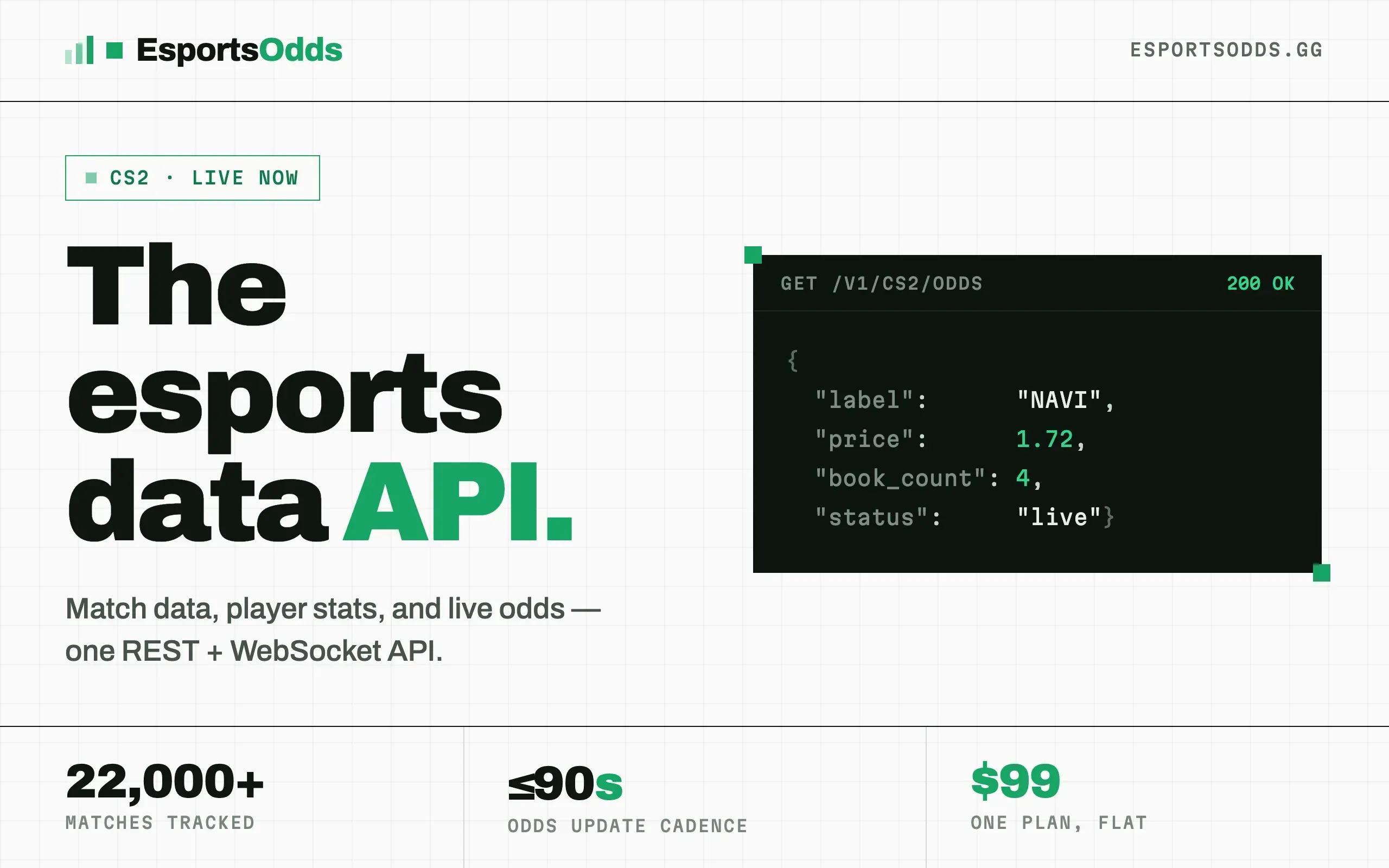
EsportsOdds is a specialized data API focused exclusively on Counter-Strike 2 (CS2) esports. It delivers match data, team and player statistics, tournament information, and a consolidated market odds line through a single REST + WebSocket interface. The service targets developers building match pages, data products publishing stats, and trading desks needing historical odds for backtesting. By narrowing its scope to one game initially, EsportsOdds aims to provide deeper, more reliable data than general-purpose sports APIs that spread resources across many titles. The platform currently covers CS2 with plans to expand to League of Legends, Dota 2, and Valorant on a public roadmap. Pricing is a flat $99 per month for 10,000 requests, with a 7-day free trial. The company positions itself as a developer-friendly alternative to scraping or using fragmented data sources, offering normalized schemas, push updates via WebSocket, and append-only historical data.
Key Features
Market Odds Line – EsportsOdds publishes a single market odds line for every tracked CS2 match, built from multiple bookmaker sources. Each odds entry includes the outcome key, label, price, book count, and capture timestamp. The line refreshes on a sub-90-second cadence, and the WebSocket stream pushes updates the moment a line changes. This allows developers to display live odds without polling.
REST Endpoints for Six Resources – The API exposes six core endpoints: /v1/cs2/odds for the market line, /v1/cs2/matches for live/scheduled/finished matches, /v1/cs2/players for player profiles and per-match stats, /v1/cs2/teams for team records and rosters, /v1/cs2/tournaments for event stages and brackets, and /v1/cs2/ws-token to mint a 60-second WebSocket ticket. All responses follow a consistent, documented schema.
WebSocket Push Updates – Instead of polling, users can open a WebSocket connection after obtaining a short-lived token. The stream notifies the client the moment a line or score updates, enabling real-time UI updates with minimal latency. This is particularly valuable for live match pages and trading dashboards.
Append-Only Historical Data – Every odds capture is appended with a UTC timestamp and never overwritten. This creates a time series of line movements that can be replayed for backtesting or analysis. The platform retains 100% of ticks, allowing users to see how prices drifted pre-game, swung during maps, or recovered.
Normalized Schema Across Resources – All endpoints return data in a uniform structure with stable identifiers for teams, players, and tournaments. This eliminates the need to map IDs across different sources and simplifies integration. The schema is documented in an OpenAPI reference.
Single Flat Pricing – One plan at $99 per month includes all endpoints, WebSocket access, and 10,000 requests. No tiers, no metering surprises, and no sales calls. Higher volume users can contact sales for custom pricing. A 7-day free trial is available with a credit card.
How It Works
To start using EsportsOdds, a developer signs up on the website and receives an API key. Authentication is done via an Authorization: Bearer header on every request. The quickstart guide demonstrates three steps: create a key, call the REST API, and open the update stream.
First, the developer makes a GET request to /v1/cs2/odds to fetch the current market line for all tracked CS2 matches. The response includes match identifiers, outcome labels (e.g., team names), prices, book counts, and capture times. For more specific data, the developer can query /v1/cs2/matches with filters like status=live to get only ongoing matches, or use the teams and players endpoints to enrich displays.
For real-time updates, the developer posts to /v1/cs2/ws-token to mint a 60-second WebSocket ticket. Using that token, they open a WebSocket connection to the stream endpoint. The server pushes notifications whenever a line or score changes, allowing the client to re-fetch only the affected data. This pattern reduces bandwidth and keeps UIs current without constant polling.
Daily use involves integrating these calls into a backend service or frontend application. The API is language-agnostic and works with any HTTP client. EsportsOdds provides documentation and guides for common use cases, such as building a match page or publishing odds on a website.
Use Cases
Developer Building a CS2 Match Page – A developer creating a fan site or tournament hub can use the matches and odds endpoints to display live scores, upcoming matches, and current betting lines. The WebSocket stream ensures the page updates automatically when a team wins a map or odds shift. Stable team and player IDs allow linking to detailed stat pages.
Data Product Publishing Esports Stats – A media outlet or analytics platform can pull player and team stats normalized across tournaments. The market odds line can be published alongside match previews or recaps, providing readers with context on which team is favored. The append-only history enables trend charts showing how odds moved over time.
Trading Desk Backtesting Models – A quantitative analyst can download historical odds data to backtest trading strategies. Because every tick is retained with timestamps, the analyst can simulate trades at the exact prices that existed. This is more accurate than using delayed or aggregated data.
Esports Betting Site Integrating Odds – A betting operator can use the market odds line as a reference or feed into their own systems. The normalized schema and push updates reduce integration effort compared to scraping multiple bookmakers. The single flat pricing simplifies cost forecasting.
Researcher Analyzing Market Efficiency – An academic or industry researcher can study how CS2 odds move in response to match events. The time-series data allows analysis of price discovery, market depth, and the impact of roster changes or tournament results.
Pricing & Value
EsportsOdds offers a single plan at $99 per month, which includes 10,000 API requests, access to all six REST endpoints, and the WebSocket stream. There are no hidden fees or overage charges; users who exceed the limit can contact sales for custom pricing. A 7-day free trial is available, requiring a credit card but allowing cancellation before the trial ends.
Compared to building an in-house scraping infrastructure, the pricing is competitive for small to medium-scale projects. The cost covers maintenance, data normalization, and uptime. However, for high-volume users (e.g., large trading desks or media sites), 10,000 requests may be restrictive, and custom pricing is not publicly listed. The value proposition is strongest for developers who need reliable, structured CS2 data without operational overhead.
Final Verdict
EsportsOdds delivers a focused, well-documented API for CS2 data that solves real integration pain points. The normalized schema, WebSocket push, and append-only history are thoughtful features that differentiate it from generic sports APIs. The flat pricing is transparent and developer-friendly. However, the limited request quota and single-game focus may not suit everyone. The roadmap for additional titles is promising but not yet delivered. Overall, EsportsOdds is a solid choice for developers and data products that prioritize CS2 and want a clean, reliable data feed. For those needing multi-game coverage or higher volume, it may be worth waiting for the roadmap to materialize or negotiating custom terms. Check out their pricing page for details, explore the API documentation for technical specs, or read about their methodology for data sourcing.
Pros & Cons
The Good
- Normalized schema across all six API endpoints reduces integration complexity for developers.
- WebSocket push updates deliver odds and score changes in near real-time without polling.
- Append-only historical data preserves every odds tick with UTC timestamps for accurate backtesting.
- Single flat pricing at $99 per month with no tiers or hidden fees simplifies budgeting.
- Focused exclusively on CS2 ensures deeper coverage and higher data quality than multi-sport APIs.
The Bad
- Only CS2 is currently supported; other esports titles are on the roadmap but not yet available.
- The 10,000 request monthly limit may be insufficient for high-traffic applications without custom pricing.
- No free tier exists beyond the 7-day trial, which may deter hobbyists or very small projects.