erecruit
erecruit links every open Australian government ICT opportunity to the tender panel agency job ad behind it, giving recruiters a verified map of live contracts.
Overview
erecruit is an Australian recruitment intelligence platform built for one specific niche: government ICT labour hire. Instead of collecting job advertisements the way a conventional job board does, it starts from the procurement side. The platform monitors open opportunities published on BuyICT and matches each one to the tender-panel agency advertisement that corresponds to it. The output is a linked record showing which government contract sits behind which recruitment ad, along with the evidence used to make the connection. The intended user is a labour-hire recruiter or agency account manager who places ICT contractors into Australian government panels. A secondary audience is anyone doing business development against tender panels, since the same linkage reveals which agency is already chasing a given opportunity. The service is subscription-based, English-language, and deliberately limited to Australian government ICT work rather than general recruitment.
Key Features
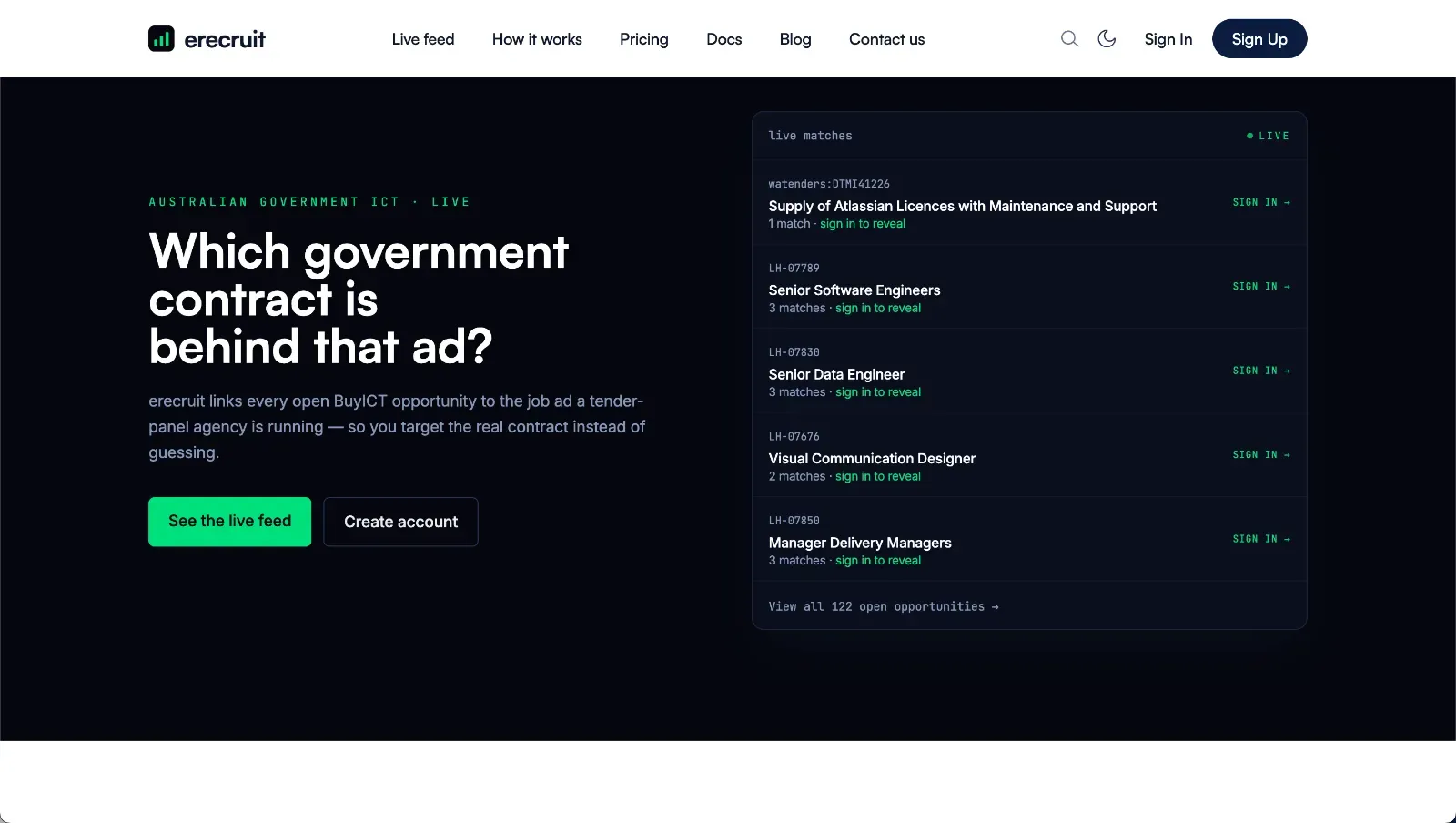
- Opportunity intelligence linking contracts to ads. Every open government ICT opportunity in the feed is paired with the agency job ad running against it. The matching record includes the role, security clearance level, location, and timing, so a recruiter can verify why a link was made instead of trusting an opaque score. The public feed currently displays 122 open opportunities, each annotated with the number of matches found.
- Explainable CV matching. Recruiters upload candidate CVs and receive a score for each role, along with the reasons behind that score. Rather than returning a single ranking number, the system surfaces the evidence that produced it, which supports defensible shortlisting and gives account managers something concrete to discuss with clients.
- Candidate search and import. The platform lets teams find candidates from external sources and import them into their own workspace, where the records are cached. This keeps sourcing and pipeline management in one place rather than spreading candidate data across a browser, a spreadsheet, and an applicant tracking system.
- Pipeline kanban filtered by opportunity. Candidates move through hiring stages on a drag-and-drop board, and the board can be filtered to a specific opportunity. Working per opportunity matters in labour hire because the same contractor pool is often being considered against several unrelated tender requirements at once.
- Consent gate before submission. Before a candidate is put forward, the system requires that representation consent be requested and recorded. For agencies operating under Australian government panel rules, being able to demonstrate that consent was captured is a practical safeguard rather than a formality.
- Recruiter dashboard. A summary view aggregates key performance indicators, CV matches, items flagged for review, and recent activity. It functions as a daily starting point for a recruitment desk, showing what changed since the last visit.
- Government buyer and agency directories. Beyond the live feed, the site publishes pages listing government buyers and recruitment agencies, giving users a way to look up counterparties and understand the shape of the panel market they are selling into.
How It Works
The workflow is described on the site as four moves. First, BuyICT publishes labour-hire opportunities as soon as they open, and erecruit picks them up. Second, the platform links tender-panel agency advertisements to each opportunity using role, clearance, location, and timing as the evidence set. Third, recruiters upload CVs and the system scores each candidate against each role, displaying the reasoning behind the result. Fourth, the desk runs the pipeline: sourcing candidates, moving them from unqualified through to placed, and gating submissions on recorded consent.
The practical loop for a recruiter is straightforward. Open the live feed, scan the current opportunities and their match counts, pick the ones relevant to the contractor pool available, upload or search for candidates, review both the CV scores and the match evidence, then push qualified people through the kanban while the consent request is captured. Items the system cannot confidently classify appear in a needs-review queue rather than being acted on automatically.
Use Cases
A boutique labour-hire agency holding a place on a federal ICT panel can use the feed to spot a newly published Senior Data Engineer opportunity and immediately see which agency ads are already running against it. That indicates whether the desk is early or late to a requirement, and whether the client's own advertisement is consistent with the underlying contract.
An account manager preparing a rate card for an Atlassian licensing support requirement can cross-reference the tender code against the live link, confirm the role, clearance, and location, and shortlist three contractors whose CVs have already been scored against that specific role rather than against the general pool.
A recruitment business development lead uses the buyer and agency directories alongside the feed to identify which government buyers are active and which agencies are bidding. Because the site also tracks recently closed opportunities, the same data supports after-action review, showing which contracts closed and how long each remained open.
A solo recruiter without a full applicant tracking system can import candidates into the workspace and use the kanban plus consent gate as a lightweight operating system for a desk, avoiding a separate ATS subscription for a small contractor book.
Who It's For
erecruit targets Australian labour-hire recruiters and tender-panel agencies placing ICT contractors into government. It also suits business development staff who need visibility into which agency is pursuing which contract. It is not a fit for generalist recruiters, non-Australian markets, or permanent-placement desks outside ICT.
Alternatives fall into two groups. General job aggregators list advertisements but do not connect them to the underlying procurement opportunity, so the contract context is missing. Enterprise procurement intelligence tools cover tender data broadly but do not pair it with recruitment advertising, CV scoring, or a candidate pipeline. erecruit occupies the space in between, and its value depends on how much of a desk's work happens inside Australian government ICT.
Pros & Cons
The Good
- Links each open BuyICT opportunity to the specific tender-panel agency job ad behind it, with role, clearance, location, and timing cited as evidence.
- CV matching returns a score plus the reasoning behind it, which supports defensible shortlisting rather than an unexplained ranking number.
- A consent gate forces representation consent to be captured before any candidate is submitted to a government opportunity.
- Opportunity-filtered kanban boards let one contractor pool be tracked against several unrelated tender requirements at the same time.
- The live feed exposes 122 open opportunities with per-opportunity match counts, giving a desk an immediate read on market activity.
The Bad
- Match detail is gated behind sign-in, so the strength of the linking data cannot be evaluated before creating an account.
- The dataset is tightly scoped to Australian government ICT labour hire, which limits usefulness for recruiters in other sectors or geographies.
- Footer social and community links resolve to placeholder anchors, leaving no public channel for product updates or peer discussion.