
StepKcal
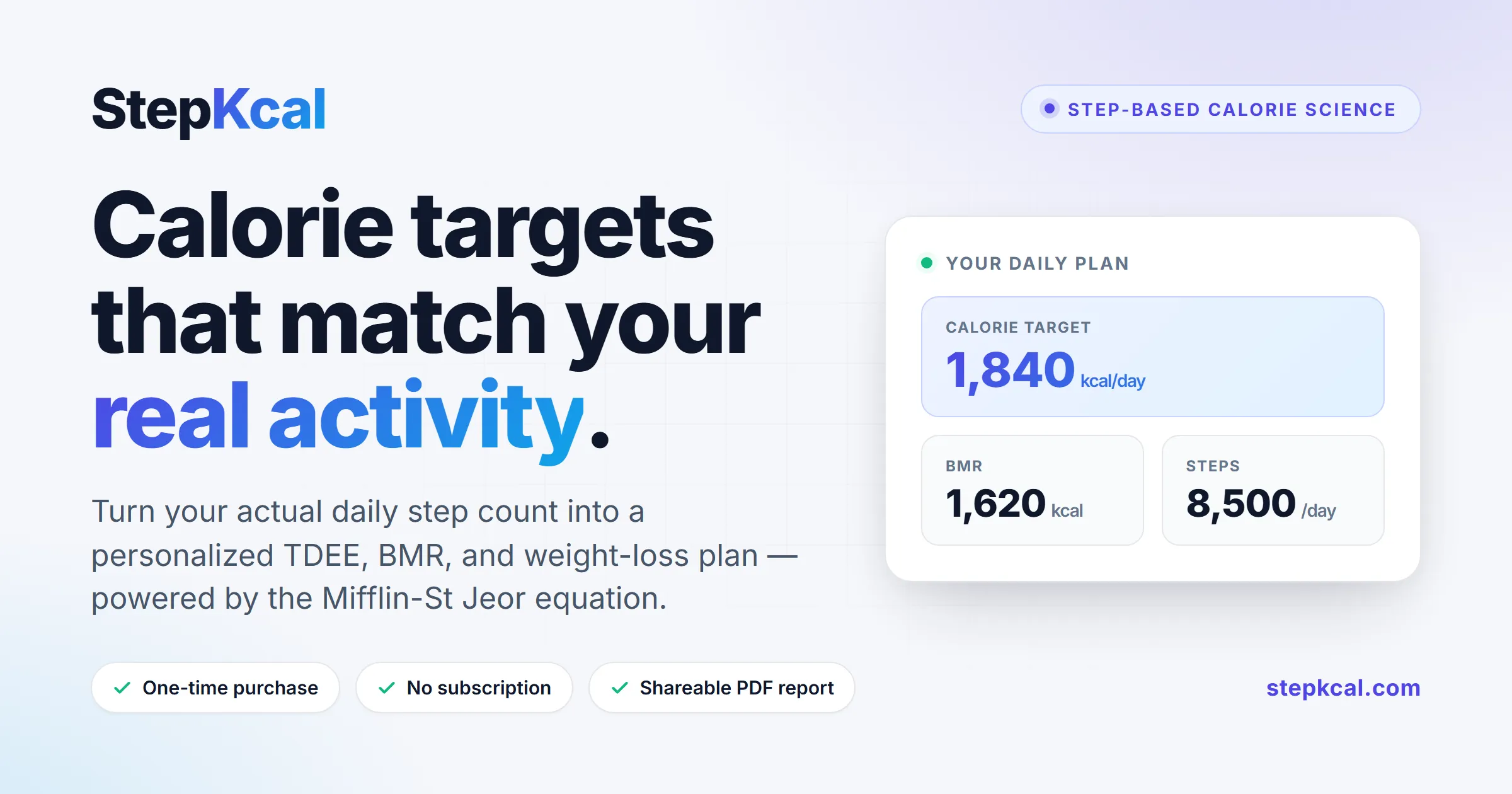
StepKcal uses real daily step counts to calculate personalized calorie targets and weight-loss plans via the Mifflin-St Jeor equation.
Overview
StepKcal is a specialized web application that bridges the gap between physical activity tracking and personalized nutrition planning. Unlike generic calorie calculators that rely on vague activity level descriptions (sedentary, lightly active, etc.), StepKcal uses a user's actual daily step count to compute total daily energy expenditure (TDEE) and recommend precise calorie targets for weight loss. The tool is built around the Mifflin-St Jeor equation, a widely validated formula for estimating basal metabolic rate (BMR), and incorporates step data to estimate non-exercise activity thermogenesis (NEAT). The result is a tailored calorie plan that reflects real-world movement patterns rather than subjective self-assessment.
The product positions itself as a science-backed alternative to subscription-based diet apps. It offers a one-time purchase model with no recurring fees, which appeals to users who want a straightforward, evidence-based calculation without ongoing commitments. The interface is clean and minimal, focusing on data entry and report generation. StepKcal targets health-conscious individuals, fitness enthusiasts, and anyone seeking a data-driven approach to weight management. By eliminating guesswork around activity levels, it aims to improve the accuracy of calorie recommendations and help users set realistic, sustainable goals.
Key Features
Step-Based TDEE Calculation
StepKcal's core feature is its ability to convert daily step counts into an estimate of total daily energy expenditure. Users input their average steps per day, and the system calculates calories burned from walking based on step count, weight, and walking pace. This step-derived energy expenditure is added to the BMR and a baseline NEAT estimate to produce a personalized TDEE. This approach removes the ambiguity of standard activity multipliers and provides a more objective foundation for calorie planning.
Mifflin-St Jeor BMR Formula
The application uses the Mifflin-St Jeor equation, one of the most accurate formulas for estimating resting metabolic rate. It accounts for age, gender, height, and weight. This formula is preferred by many nutrition professionals for its reliability across diverse populations. StepKcal applies it consistently, ensuring that the BMR component of the TDEE calculation is grounded in established research.
Personalized Weight-Loss Paces
Users can choose from multiple deficit levels: a recommended pace (0.5 kg per week), a more aggressive option (0.7 kg per week), or maintenance calories. The recommended pace is automatically suggested based on the user's BMI category. For example, individuals in the overweight range receive a moderate deficit recommendation, while those with higher BMIs may see a more aggressive option. Each pace displays the corresponding daily calorie target, making it easy to compare trade-offs between speed and sustainability.
Macronutrient Breakdown
For each calorie target, StepKcal provides a suggested macronutrient split: 30% protein, 40% carbohydrates, and 30% fats. This is presented in grams per day, helping users translate calorie goals into actionable food choices. The macro distribution is fixed but aligns with general dietary guidelines for weight loss. Users can see how protein, carbs, and fat grams change across different deficit levels.
Weekly Weight Projection
A table shows projected body weight at two-week intervals until the user reaches their desired weight. This projection assumes consistent adherence to the chosen calorie target and provides a visual timeline for goal achievement. The table includes all three paces side by side, allowing users to compare how different deficit levels affect the time required to reach their goal.
Detailed Calculation Breakdown
A transparent breakdown shows how each component of the TDEE is derived: BMR, calories burned from steps, non-step NEAT, and the resulting maintenance calories. The deficit amounts for each pace are also listed. This transparency helps users understand the logic behind their numbers and builds trust in the tool's methodology.
One-Time Purchase Model
StepKcal operates on a single payment of $1.99 (with a limited-time discount from $2.99). There are no subscriptions, no recurring charges, and no account creation required. Users pay once and receive a shareable report. This model is refreshingly simple compared to the monthly fees of many competing apps.
How It Works
StepKcal's user journey is straightforward and can be completed in under two minutes. First, the user lands on the homepage and sees a form titled "Your details." The form collects age, gender, height, weight, desired weight, average daily steps, and walking pace. A unit toggle allows switching between metric and imperial systems. The step count field is accompanied by a hint suggesting users check their phone or fitness tracker for an accurate average.
After filling in the fields, the user clicks the "Get My Calorie Plan" button, which initiates a one-time payment of $1.99 via an integrated checkout. No account or email is required at this stage. Once payment is confirmed, the system generates a personalized report that includes all the features described above: BMI assessment, calorie breakdown, macronutrient targets, weekly weight projection, and a detailed calculation summary.
The report is designed to be shareable, with a unique URL that can be saved or sent to a coach, doctor, or friend. The interface includes a preview section on the homepage that shows example data from a sample report, giving potential users a clear idea of what they will receive before purchasing. This preview builds confidence and reduces friction in the buying decision.
Use Cases
A Sedentary Office Worker Starting Weight Loss
A 35-year-old woman who works at a desk and averages 4,000 steps per day wants to lose 10 kg. She enters her details and discovers her maintenance calories are 1,900 kcal per day. The recommended deficit of 0.5 kg per week gives her a target of 1,350 kcal. She can see that increasing her steps to 8,000 per day would raise her maintenance calories, allowing a higher food intake while still losing weight. This insight motivates her to incorporate short walks into her lunch break.
A Fitness Enthusiast Optimizing Body Composition
A 28-year-old man who walks 12,000 steps daily and lifts weights three times per week wants to lose fat while preserving muscle. He uses StepKcal to find his maintenance calories at 2,800 kcal. He selects the 0.5 kg per week deficit, giving him 2,250 kcal with 169 g of protein. The macro breakdown helps him plan meals that meet his protein needs. He appreciates that the calculation is based on his actual step count rather than a generic "active" label.
A Health Coach Creating Plans for Clients
A nutrition coach uses StepKcal to generate baseline calorie recommendations for new clients. By having clients input their own step data, the coach can quickly produce personalized reports without manual calculations. The transparent breakdown helps the coach explain the science behind the numbers, building client trust. The one-time fee per report is cost-effective compared to subscription tools.
A Person Recovering from Injury
After a knee injury, a 45-year-old man's step count drops from 10,000 to 3,000 per day. He uses StepKcal to recalculate his calorie needs and finds his maintenance has dropped by 300 kcal. He adjusts his intake accordingly to avoid weight gain during recovery. The tool helps him stay on track without relying on guesswork.
A Couple Pursuing Weight Loss Together
A husband and wife both want to lose weight. They each purchase a report and compare their calorie targets. The husband, who is taller and more active, gets a higher maintenance level. They use the macronutrient breakdowns to plan shared meals that fit both their goals. The weekly projection table helps them set joint milestones and celebrate progress together.
Pricing & Value
StepKcal uses a straightforward one-time payment model. The standard price is $2.99, but a limited-time discount brings it to $1.99. This single payment grants access to a personalized report that includes all calculations, projections, and macronutrient breakdowns. There are no tiers, no upsells, and no hidden fees. The report is accessible via a unique URL and can be revisited anytime.
Compared to subscription-based competitors like MyFitnessPal Premium ($19.99/month) or Noom ($60/month), StepKcal offers a fraction of the cost for a focused, science-backed calculation. However, it lacks ongoing features like meal logging, recipe databases, or community support. The value proposition is clear: users pay once for a precise, data-driven starting point, then implement the plan using their own tools. For those who prefer a one-time investment over recurring fees, StepKcal is an excellent deal.
Final Verdict
StepKcal delivers on its promise of a step-based, personalized calorie calculation. Its use of the Mifflin-St Jeor formula and transparent methodology sets it apart from generic online calculators. The one-time pricing model is refreshing in a market dominated by subscriptions. The interface is clean and easy to navigate, and the preview section helps users understand what they are buying.
Areas for improvement include the lack of an integrated food diary or activity tracker, which means users must rely on external tools to execute the plan. The macronutrient split is fixed and may not suit all dietary preferences (e.g., low-carb or ketogenic diets). Additionally, the tool does not account for other forms of exercise beyond walking, which could affect TDEE for those who run, cycle, or lift weights.
StepKcal is best suited for individuals who want a reliable, one-time calorie calculation based on real step data and are comfortable managing their own meal planning. It is also a useful resource for health coaches and trainers who need quick, accurate reports for clients. For those seeking an all-in-one weight loss app with tracking and coaching, StepKcal may feel limited. But for its specific niche, it performs admirably.
For more details, check out their pricing or read their blog for additional insights. The privacy policy outlines data handling practices.
Pros & Cons
The Good
- Uses actual daily step count instead of vague activity level descriptions for more accurate TDEE calculation.
- One-time purchase model with no subscription fees, making it affordable and transparent.
- Transparent calculation breakdown shows BMR, step calories, NEAT, and deficit amounts.
- Includes weekly weight projection table for three different paces to visualize progress.
- Provides macronutrient targets in grams based on a balanced 30/40/30 split.
The Bad
- Does not integrate with fitness trackers or smartwatches for automatic step data import.
- Macronutrient split is fixed and cannot be customized for different dietary approaches.
- Lacks a food diary or meal logging feature to track daily intake against targets.