Soku AI
Soku AI is an AI marketing agent that automates ad campaigns, SEO, social media, and competitive analysis so you can focus on strategy.
Overview
Soku AI is an AI-powered marketing agent designed to automate campaign analytics, SEO, social media management, and competitive analysis. It connects to a user's entire marketing stack, replacing days of manual data gathering with instant, expert-level intelligence. Built for performance marketers, SEO specialists, social media managers, and growth leads, Soku AI addresses the core problem of fragmented data across multiple platforms. By unifying context from ad platforms, analytics tools, and creative engines, it enables faster investigation and action-ready outputs. The product is currently free during beta, making it accessible for teams of all sizes.
Key Features
- Unified Data Context: Soku AI connects to over 20 marketing platforms including Meta Ads, Google Ads, TikTok Ads, Reddit Ads, GA4, Shopify, Semrush, HubSpot, Instagram, LinkedIn, X/Twitter, OpenAI, Midjourney, Runway, Notion, and Mailchimp. All connections are read-only, ensuring data security. This unified context allows users to ask cross-channel questions and receive answers with consistent definitions across all marketing data.
- Root-Cause Analysis: The agent detects what moved performance by analyzing spend shifts, engagement drops, funnel leakage, attribution gaps, and content fatigue. Users can pinpoint exactly what drove changes in performance across paid, organic, email, and more. This feature turns raw data into prioritized insights, saving hours of manual investigation.
- Cross-Channel Comparisons: Users can compare paid vs organic, channel vs channel, segment vs segment with the same question and consistent output. For example, comparing Meta vs Google vs TikTok efficiency over 30 days or analyzing which audiences outperform across all ad platforms.
- Alerts and Narratives: Soku AI turns anomalies into actionable summaries. It provides a clear narrative of "what happened, why it happened, and what to do next." This helps teams respond quickly to performance shifts without digging through multiple dashboards.
- Action Plan Generation: The agent can draft weekly marketing recaps, campaign backlogs, scaling plans, and experiment hypotheses. It generates campaign plans, budget shifts, content briefs, audience segments, and next steps, enabling teams to move from insight to action in minutes.
- Pre-Built Question Templates: The interface includes a library of example questions for different roles. Performance marketers can ask "Why did CPA spike yesterday across Meta and Google?" while SEO specialists can query "What keyword gaps do we have vs our top 3 competitors?" These templates accelerate onboarding and provide immediate value.
- Integrations with Creative Tools: Beyond analytics, Soku AI connects to creative generation tools like OpenAI, Midjourney, Runway, Higgsfield, and Creatify. This allows users to generate ad copy, blog drafts, email sequences, marketing visuals, and video ads directly within the platform.
How It Works
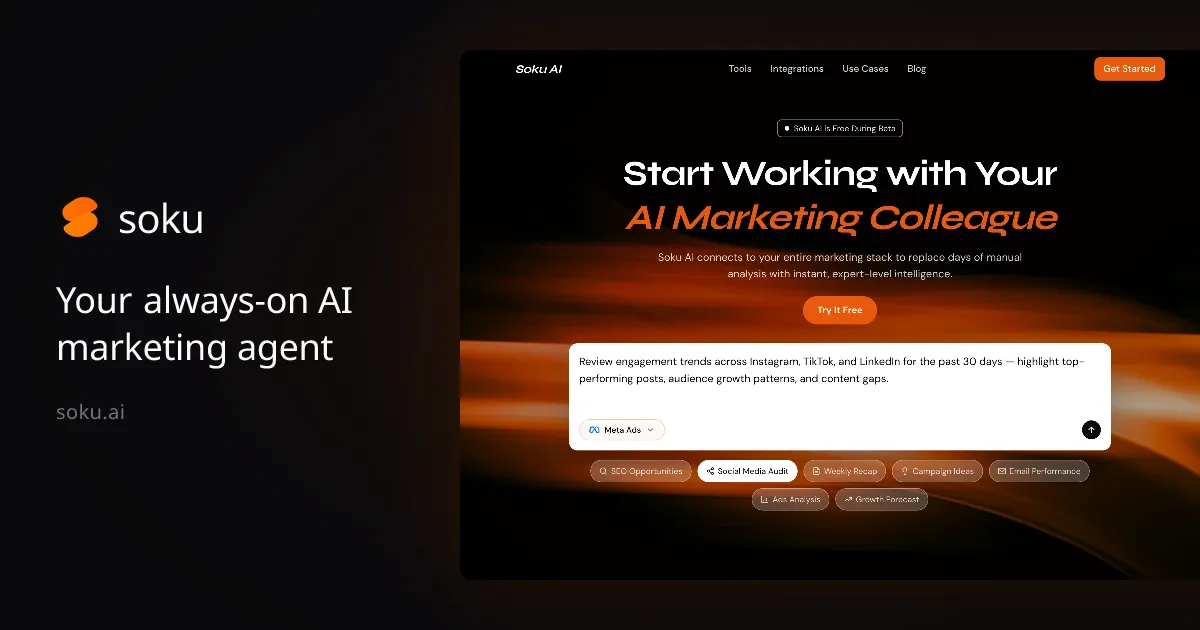
Getting started with Soku AI takes under 15 minutes. Users sign up and connect their marketing accounts via read-only API integrations. The platform supports a wide range of data sources including ad platforms, analytics tools, social media, and creative engines. Once connected, users can ask questions in natural language through a chat interface. The agent processes the query, pulls relevant data from connected sources, and returns a structured answer with data context. For example, a user can type "Compare Meta vs Google vs TikTok efficiency over 30 days" and receive a cross-channel comparison with metrics like ROAS, CPA, and conversion rates. The system also supports pre-built prompts for common tasks like SEO opportunities, social media audits, weekly recaps, and campaign ideas. Results are presented as text summaries with optional visual elements. The agent is always on, available whenever performance shifts occur, and can generate action plans that include budget reallocations, content briefs, and experiment hypotheses.
Use Cases
- Performance Marketer: A performance marketer managing campaigns across Meta, Google, and TikTok can ask Soku AI "Why did CPA spike yesterday across Meta and Google?" The agent analyzes spend shifts, engagement drops, and attribution gaps to pinpoint the root cause and recommends budget reallocations to protect ROI.
- SEO Specialist: An SEO specialist can query "What keyword gaps do we have vs our top 3 competitors?" Soku AI pulls data from Semrush and GA4 to identify ranking opportunities, suggests content updates, and drafts content briefs for high-opportunity keywords.
- Social Media Manager: A social media manager can ask "Which posts had the highest engagement rate this week?" The agent analyzes Instagram, LinkedIn, and X/Twitter data to identify top-performing content formats and posting times, then drafts five post ideas based on winning themes.
- Email/CRM Marketer: An email marketer can query "Which email campaigns had the highest open and click-through rates?" Soku AI connects to Mailchimp and HubSpot to compare drip sequence conversions, identify underperforming automated flows, and suggest A/B test ideas for product launch emails.
- CMO/Growth Lead: A CMO can ask "What is blended CAC across all channels this week vs last?" The agent provides a full-funnel conversion rate from awareness to purchase, compares organic vs paid revenue contribution, and projects the revenue impact of doubling SEO investment.
Who It's For
Soku AI is built for marketing professionals at companies of all sizes, from solo founders to enterprise teams. It is ideal for performance marketers, SEO specialists, social media managers, email/CRM marketers, and CMOs or growth leads who need to make data-driven decisions quickly. The product requires no technical expertise to set up or use. Compared to alternatives like Supermetrics or Funnel.io, Soku AI offers a conversational interface and built-in action plan generation rather than just data aggregation. Unlike traditional BI tools, it provides prescriptive insights and next steps, not just dashboards. The free beta pricing makes it particularly attractive for startups and small teams looking to automate marketing analysis without upfront investment.
Pros & Cons
The Good
- Unifies data from over 20 marketing platforms into a single conversational interface.
- Provides root-cause analysis that identifies why performance changed, not just what changed.
- Generates actionable outputs like campaign plans, budget shifts, and content briefs.
- Offers pre-built question templates for different marketing roles to accelerate onboarding.
- Free during beta with no upfront cost, making it accessible for teams of all sizes.
The Bad
- Limited to read-only connections, so it cannot execute changes directly in ad platforms.
- Currently in beta, so some features may be incomplete or subject to change.
- Requires integration setup for each data source, which may take time for larger stacks.