

Saga20
Saga20 is an AI-powered campaign tracker and world builder for D&D, Pathfinder, and any TTRPG that records sessions, generates instant summaries, and automatically builds a wiki.
Overview
Saga20 is an AI-powered campaign tracker and world builder designed for tabletop role-playing games (TTRPGs) like Dungeons & Dragons, Pathfinder, and Call of Cthulhu. It solves the problem of manual note-taking and world-building by automatically generating session summaries, recognizing player voices, and maintaining a living wiki that updates after every session. Built for dungeon masters who want to focus on storytelling rather than administrative overhead, Saga20 combines audio recording, natural language processing, and graph-based world mapping into a single platform. The tool supports multiple game systems and offers a free tier to get started.
Key Features
-
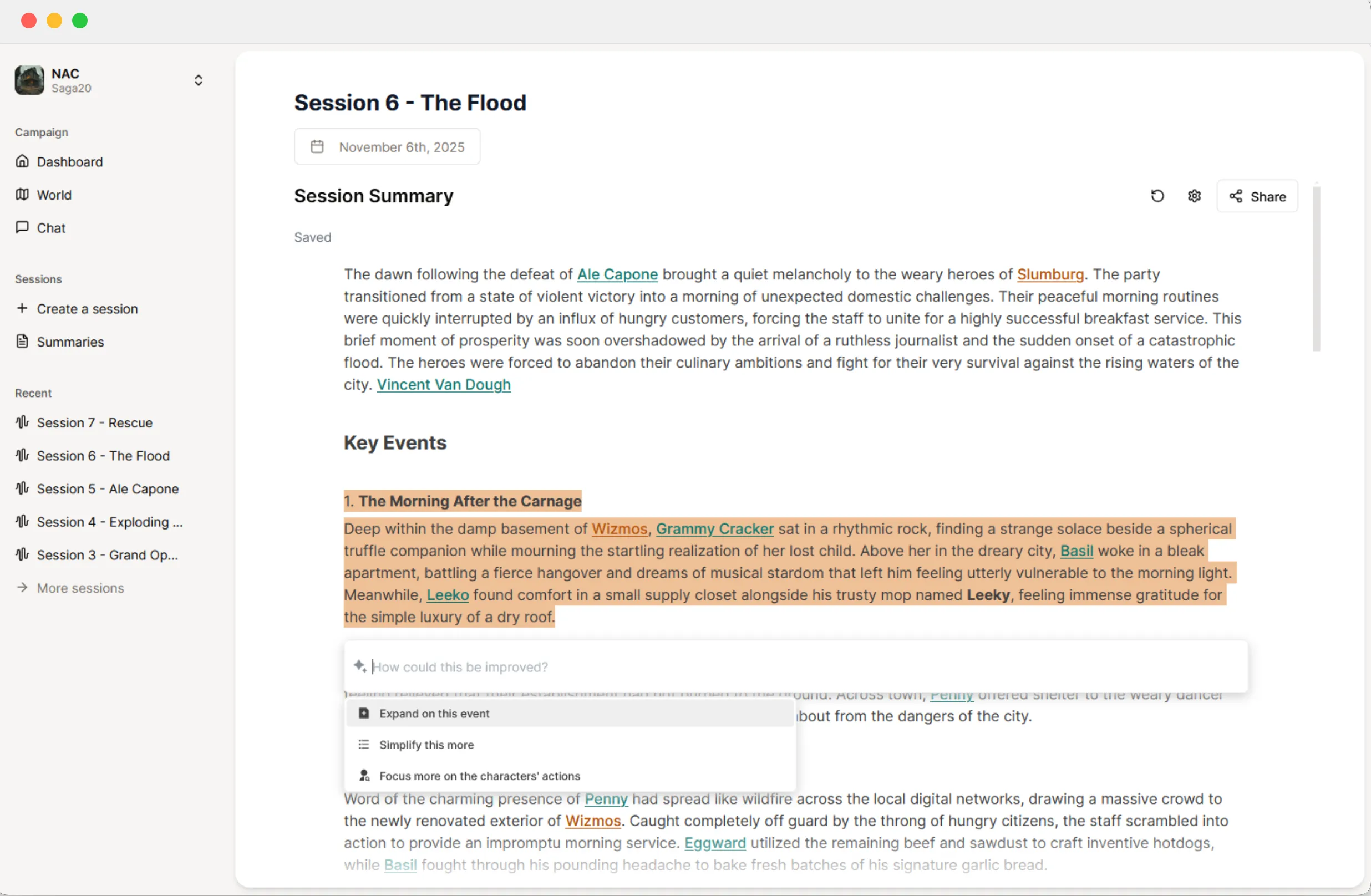
Session Recording and Summarization: Users upload audio files from their game sessions. Saga20 processes the audio to produce structured session notes and a concise summary. The system identifies key events, player decisions, and plot threads, organizing them in a readable format. The summary can be edited and shared with players via a public link.
-
Voice Auto-Match: After the first session, Saga20 creates voice fingerprints for each player. In subsequent recordings, it automatically recognizes who is speaking without manual tagging. This feature works across sessions and helps attribute dialogue and actions to the correct characters.
-
World Builder with Campaign Graph: The world builder allows users to manage characters, NPCs, locations, factions, and items in a unified workspace. Entities can be linked using @-mentions, and the Campaign Graph visualizes all connections automatically. Entity pages update after each session, reflecting new information without manual editing.
-
Auto-Wiki: The wiki updates itself after every session summary is generated. Saga20 identifies which characters, locations, and factions were involved and updates their pages accordingly. This eliminates the need for manual wiki maintenance, a key differentiator from tools like World Anvil or Kanka.
-
Sharing and Discord Integration: Session summaries can be shared with players via a public link that requires no login. The platform also offers Discord integration, allowing users to publish formatted recaps directly to a Discord server with one click. Players can subscribe to email notifications for new summaries.
-
Multi-System Support: Saga20 supports multiple TTRPG systems including D&D (all editions), Pathfinder (1e and 2e), Call of Cthulhu, Cyberpunk RED, and Vampire: The Masquerade. The tool adapts to the chosen system's terminology and conventions.
-
Pricing Tiers: The free tier includes one session summary with full voice recognition and unlimited text notes. Paid plans start at $12.99/month for 6 sessions, $19.99/month for 12 sessions, and $39.99/month for 24 sessions, with additional storage and features like Campaign Chat and priority support.
How It Works
Users start by creating a free account on Saga20's web app. After selecting their game system, they can upload an audio recording of a session. The platform processes the audio and generates a session summary within minutes. The summary includes key events, character interactions, and plot developments. Users can review and edit the summary before publishing. The world builder is accessible from the dashboard, where users can add entities and link them using @-mentions. After each session, the wiki updates automatically. Sharing is done by toggling session visibility and copying a public link. Discord integration requires connecting a campaign to a Discord server, after which summaries can be posted with one click. The entire workflow is designed to minimize setup and manual data entry.
Use Cases
-
A busy dungeon master running a weekly D&D campaign: The DM records each session using a phone or microphone. Saga20 generates summaries that capture key events and player decisions, saving hours of note-taking. The auto-wiki ensures that NPCs, locations, and factions are always up to date.
-
A Pathfinder group playing online via Discord: The group records their sessions using Craig or OBS. The DM uploads the audio to Saga20, which recognizes each player's voice and attributes dialogue correctly. Summaries are shared with players who missed sessions, keeping everyone informed.
-
A Call of Cthulhu keeper managing a complex investigation: The keeper uses the world builder to track clues, NPCs, and locations. The Campaign Graph reveals connections between entities, helping the keeper plan future sessions. The auto-wiki updates after each session, ensuring no detail is lost.
-
A game master running multiple campaigns across different systems: Saga20 supports unlimited campaigns on paid plans. The DM can switch between D&D, Pathfinder, and Cyberpunk RED without losing context. Each campaign has its own wiki and session history.
-
A player who wants to stay engaged between sessions: Players can subscribe to email notifications for new summaries. They can read session recaps without creating an account, making it easy to catch up on missed sessions.
Who It's For
Saga20 is built for dungeon masters and game masters who run TTRPG campaigns and want to reduce administrative overhead. It is suitable for both in-person and online games, supporting any system. The tool is designed for individuals and small groups, with pricing that scales from casual players to power users running multiple weekly games. Compared to alternatives like World Anvil (manual wiki editing) and Kanka (community-driven but manual), Saga20 differentiates itself through automatic wiki updates and voice recognition. It is also more affordable than some competitors, with a free tier that allows testing. The target audience includes hobbyists, content creators, and professional GMs who value time savings and automation.
Pros & Cons
The Good
- Automatic session summarization from audio recordings saves hours of manual note-taking.
- Voice auto-match identifies players across sessions without manual tagging.
- Auto-wiki updates entity pages after every session, eliminating manual wiki maintenance.
- Campaign Graph visualizes connections between characters, locations, and factions automatically.
- Discord integration allows one-click publishing of formatted session recaps.
The Bad
- Free tier is limited to one session summary, requiring a paid plan for regular use.
- Audio recording quality can affect accuracy, especially with poor microphone setups.
- No direct integration with virtual tabletop platforms like Roll20 or Foundry VTT.