overrank
overrank automates SEO content creation and publishing, helping businesses rank on Google and AI search engines with daily AI-written articles.
Overview
Search engine optimization has become a critical growth channel for modern businesses, but the demands of creating and publishing high-ranking content are steep. Research, writing, editing, image sourcing, metadata, internal linking, and continuous publishing consume hours per article. For many small teams, this process is not sustainable. overrank is an automated SEO platform that aims to remove those bottlenecks by handling the entire content lifecycle. The system integrates directly with major website builders such as Shopify, WordPress, Webflow, Wix, Squarespace, and GoHighLevel, as well as custom HTML sites. It sits at the intersection of AI writing, keyword research, technical SEO, and content automation, positioning itself as a more affordable alternative to a stack of separate tools.
The platform's value proposition is built on automating the tasks that usually require a dedicated SEO specialist or a team of freelance writers. The website highlights that the average blog post takes more than four hours to research, write, optimize, and publish. Freelance writers often charge between $200 and $500 per article, and agencies can cost anywhere from $3,000 to $10,000 per month. Many businesses abandon their content strategy before seeing results because the publishing pace is too difficult to sustain. overrank claims to solve this by generating a new article every day with no manual effort. It also includes technical optimization, like meta tags, schema markup, and internal linking, which many users neglect due to lack of time.
The platform is built to target not only Google but also the growing influence of AI search. The system aims to make websites discoverable in Google AI Overviews, Gemini, and Perplexity by creating authoritative, well-cited content. It supports more than 30 languages, making it a practical option for international SEO. The product is operated by Aurum Days LLC and has earned trust from over 1,150 businesses, according to the homepage. Those businesses range from local plumbers to DTC e-commerce brands, showing the product's versatility.
Key Features
Automated Keyword Research and Scoring: The keyword engine uses real search volume and difficulty data to find terms that are worth targeting. It generates a list of 30 recommendations that match the site's niche and existing authority. The platform scores each keyword on a difficulty scale so that users can see which terms are easy or hard to win. If a business has its own list, it can upload that instead. This combination of automation and custom input helps users build a data-driven SEO strategy without manually using third-party tools.
AI Article Writing with Blog DNA: The Blog DNA system reads the existing website to understand its tone, style, and target audience. It then writes articles that sound like the brand's own content, avoiding the generic AI feel that many readers find off-putting. The writing engine handles various industries, producing casual and friendly pieces for beauty brands, professional and trustworthy pieces for real estate, and evidence-based pieces for health and wellness. Articles include statistics and authoritative references, which can make them eligible to be cited by AI tools like Gemini. This feature bridges the gap between high-quality content and brand identity.
Daily Auto-Publishing: After the user approves keywords, the platform takes over. The AI researches each topic and creates a complete article, including headline, body, images, and metadata. It then publishes the article directly to the connected CMS without requiring any manual action. The system also submits the updated sitemap to Google using the Indexing API, speeding up time-to-index. This daily cadence helps businesses build topical consistency, which is a strong signal to search engines.
Schema Markup and Technical SEO: Every article is automatically enriched with schema markup in JSON-LD format, including Article and FAQ schemas where appropriate. This helps search engines understand the content and display rich snippets in search results. The platform also handles meta description, title tag, and Open Graph tags. This technical optimization is often skipped by smaller sites because it is tedious, but overrank does it on every post. For users on WordPress, the tool ensures compatibility with common SEO plugins, while on other platforms it injects the necessary code directly.
Smart Internal Linking: Internal links spread authority across the website, and overrank adds them contextually. Each new article references relevant existing pages with descriptive anchors. This helps search engines crawl the site more effectively and can boost older content. The platform sets limits to avoid over-optimization, linking only where it adds value. Over time, this creates a dense internal network that strengthens the site's topical silos.
Backlink Growth Accelerator: The backlink system combines two tactics. The first is a community network where sites with related content can link to one another, with a cap of one link per site to maintain quality. The second is the monthly creation of data-rich articles that are meant to attract natural backlinks from media, research, and resource pages. These authority pieces increase domain authority and can generate citations in academic or report-style content. The dashboard shows how many backlinks have been earned and the average time to earn the first link, making the process measurable.
Multi-Language SEO Support: The platform is built for international growth, as it can write and publish in over 30 languages including English, Spanish, French, German, Mandarin, Hindi, Arabic, Portuguese, Japanese, and many European languages. Users pick a language during setup, and the entire content pipeline works in that language. This allows a business to run localized blogs without needing native writers in each country.
How It Works
Setting up overrank takes about five minutes. The first step is to create an account and connect the company's website. The platform has direct integrations for Shopify, WordPress, Webflow, Wix, Squarespace, and GoHighLevel, and it can also handle custom HTML sites through a simple code snippet. Once connected, the tool extracts the domain's existing content to learn its voice and target audience.
Next, the user enters the keyword approval screen. overrank suggests 30 keywords that are selected based on the website's niche and current competitiveness. The user can select all of them or replace with a custom list. This step takes roughly two minutes and is the only part of the setup that requires input. The platform explains that users can approve 30 AI-picked keywords or upload their own list.
After the keywords are approved, the system activates the automation engine. For each keyword, the AI researches the topic, gathers relevant statistics and expert sources, and outlines an article. It writes the article in the brand's voice and adds a title, meta description, images, schema markup, and internal links. Finally, it publishes the article on a daily schedule, typically without further user interaction.
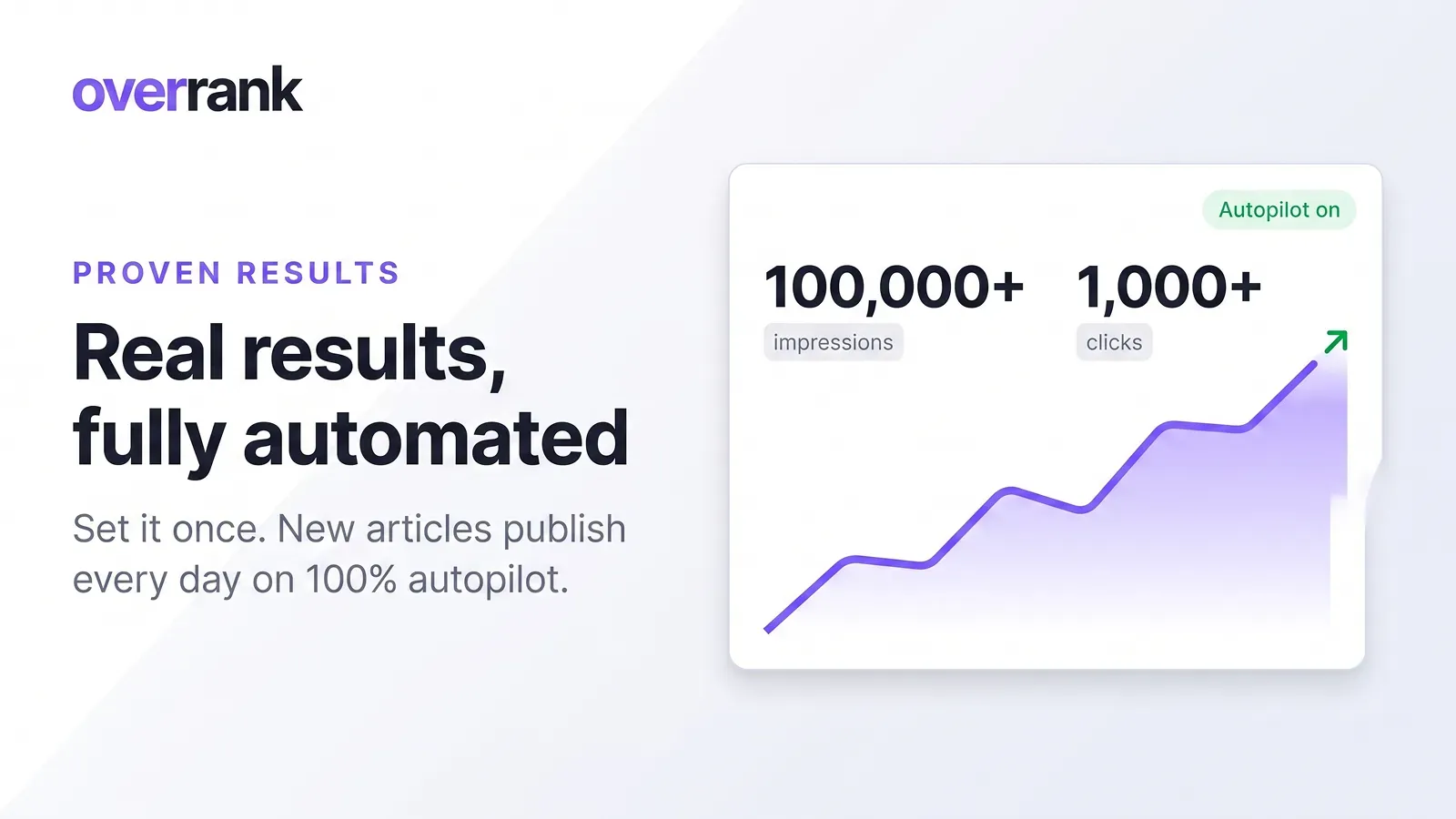
The platform automatically submits the sitemap to Google and uses the Indexing API to request indexing of new pages. From that point, the user simply monitors performance through the dashboard. The dashboard provides a live feed of new articles, organic traffic, keyword positions, backlinks, and lead events. The system is designed to run indefinitely, with no need for daily or weekly manual updates. The homepage describes it as "set it up once and let AI handle the rest."
Use Cases
Local service businesses can use overrank to target location-specific searches. A plumbing company in Chicago, for example, might see articles published for "Best Plumber Near Chicago" and for neighborhoods like Lincoln Park or Wicker Park. These articles include relevant information about emergency services, pricing, and licensing. As the pages accumulate authority, they can rank on Google and generate calls within a few months. The website showcases a ranking snippet for a plumbing keyword with 2,400 monthly clicks.
E-commerce brands use the platform to create buying guides and comparison posts that funnel shoppers to product pages. A skincare store might have content on "10-Step Korean Skincare Routine That Actually Works" and "Best Korean Skincare for Acne Scars." These articles target shoppers at the consideration stage and include internal links to product categories. According to a testimonial, one store went from 200 to 4,800 organic visitors in three months, and its MRR grew by 34%. The articles were smartly linked to product pages, improving the chance of conversion.
Digital marketing agencies that manage multiple client blogs can use overrank to standardize content production. An agency with eight clients previously spent 40 hours a week on writing and publishing. By switching to overrank, the agency can set up each client in a few minutes and have the system handle the daily publishing. The agency then spends time on strategy and reporting, increasing its capacity to take on new clients without hiring more writers.
B2B technology companies can leverage the data-driven article generation to attract authoritative links. The platform publishes monthly "backlink magnet" reports, such as industry statistics and market trend analysis. These pieces are designed to be referenceable by journalists and other content creators. As the site gains links, its domain authority rises, which helps every other piece of content rank better. Additionally, the content becomes more likely to be cited by AI search engines, including Gemini and Perplexity, leading to a new source of referral traffic.
Real estate agencies can build localized market guides that capture high-intent buyers. For example, "First-Time Home Buyer's Guide: Chicago Edition 2026" can rank for queries like "homes for sale Chicago" or "down payment assistance Illinois." The platform adjusts the tone to be professional and trustworthy, aligning with the brand's image. One agency reported a 340% increase in organic leads, showing the potential for turning a static blog into a revenue engine.
Pricing & Value
overrank offers a single Growth Plan that covers all features. The monthly price is $50, while the annual plan is $25 per month, billed at $300 per year. This makes the tool accessible for small businesses and freelancers. There is also a 7-day money-back guarantee, and the vendor promises a full refund if the product is not suitable. A free SEO audit is available before signing up, allowing potential customers to see the potential keywords and opportunities for their site.
The pricing is especially attractive when compared to the total cost of maintaining a separate SEO stack. The product's comparison table lists several tools it replaces, including AI writers like Jasper and Writesonic, keyword research tools like Ahrefs and Semrush, content optimization platforms like Surfer and Clearscope, schema plugins like Yoast and Rank Math, internal linking software, and even social media auto-posters. The combined cost of these subscriptions can reach $700 per month or more. overrank bundles the core features into one package, offering substantial savings while also reducing the complexity of managing multiple subscriptions.
The affiliate program is another notable element. Affiliates earn a 50% recurring commission, which signals that the vendor is confident in its retention rates. The platform's value also includes the ability to track leads and revenue, allowing users to calculate a direct return on their investment. The dashboard's focus on business metrics rather than vanity metrics is a differentiator in a market where many SEO tools stop at reporting traffic.
Final Verdict
overrank is a robust answer to a very real problem: sustainable SEO content production. The platform stands out because it is not merely a text generator. It wraps content creation with keyword research, technical optimization, internal linking, and backlink building, creating a closed loop that runs on its own. The Blog DNA feature addresses the common complaint that AI content sounds robotic, and the multi-language support broadens its potential use cases. The tracking dashboard is another highlight, as it connects content activity to leads and revenue, which many competing tools do not offer.
There are trade-offs to keep in mind. The pricing page has a minor inconsistency where a headline mentions "$39 for all of it," but the plan shows $50 monthly or $25 annual. This can be confusing to shoppers. The automation also means that users have limited time to review articles before they go live, which may not meet the editorial standards of heavily regulated industries. And like any SEO platform, overrank is dependent on Google's evolving policies around AI-generated content, so results can be subject to algorithm updates.
Overall, overrank is a strong option for small to medium-sized businesses, agencies, and e-commerce brands that want to delegate SEO to software. It is particularly well-suited for companies that lack the resources to hire writers or run a dedicated content operations team. Those who need granular control over every piece of content or who require full transparency into the exact wording before publishing may find the platform too autonomous. The free audit and money-back guarantee make it easy to evaluate, and the real-world results documented on the site provide evidence of its effectiveness. To explore current plans, visit the pricing page. For more on link building, see the backlinks page. To try before buying, request a free SEO audit.
Pros & Cons
The Good
- Fully automated daily publishing: writes and posts SEO articles without any manual intervention
- Integrated keyword research scores real search volume and difficulty, targeting low-competition terms
- Multi-language support covers 30+ languages, enabling global SEO with a single setup
- Automated internal linking and schema markup on every article improves technical site health
- Transparent dashboard tracks leads, clicks, and estimated revenue, not just traffic
The Bad
- Pricing page inconsistency: headline advertises $39 while plan shows $50 monthly or $25 annual
- Limited manual editorial control before articles are published due to full automation
- Dependence on Google's algorithm policies for AI content could lead to ranking volatility