Alternative.tools
Alternative.tools is an independent directory for discovering, comparing, and submitting new SaaS, AI, and productivity tools with unbiased reviews.
Overview
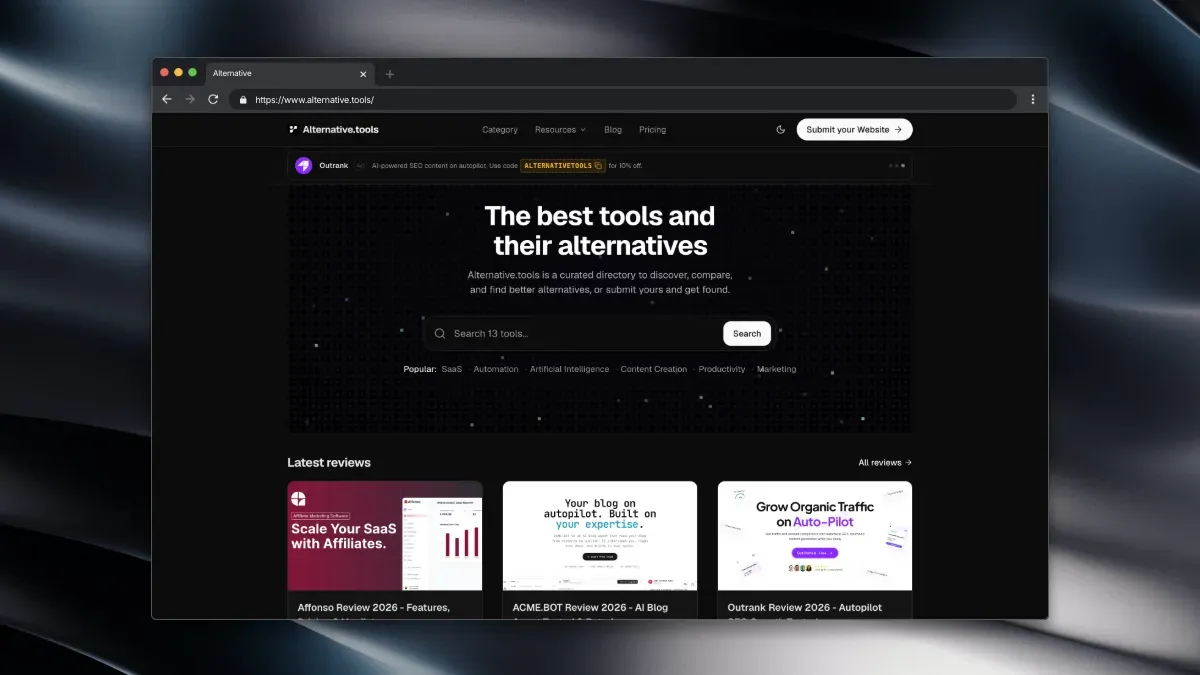
Alternative.tools is an independent platform dedicated to unbiased reviews of newly launched websites, tools, and products. The directory goes beyond simple link aggregation by publishing in-depth reviews that analyze features, pricing, and real-world potential. It positions itself as a resource for founders, marketers, and developers who need to evaluate a fast-moving SaaS and AI landscape. With a clean interface and a growing database, the platform aims to solve the problem of scattered information when comparing new software. The site currently lists around a dozen products across categories like SaaS, Automation, Artificial Intelligence, Content Creation, Productivity, and Marketing. While the number is small, the curation is deliberate, and each entry includes a thumbnail, description, and category tag. The homepage also aggregates recent reviews, top-ranked products, and popular categories, making it a useful jumping-off point for tool research.
The platform also offers a submission channel for makers seeking visibility. The site includes a dedicated pricing page that outlines options for featured listings and promotional opportunities, although the exact tiers and costs are not visible on the homepage. Beyond the directory itself, Alternative.tools produces a range of resources including guides, how-to playbooks, a glossary, and best-for lists. These resources are designed to help users understand the tool landscape and make informed decisions. The site is straightforward to navigate, with a search bar prominently placed in the hero section, allowing visitors to filter the database directly. Popular categories are displayed with emoji icons and tool counts, giving an at-a-glance view of where the content is concentrated.
Key Features
Curated Directory of New Tools
The core of Alternative.tools is its hand-picked collection of emerging products. Unlike massive directories that list thousands of tools without quality control, this platform focuses on a smaller set of rigorously evaluated items. Each entry includes a domain name, a short description, and a category label. The current database spans 13 products, but the selection is meaningful and spans multiple industries, from AI-powered content generators to affiliate software. For example, Affonso is featured as a SaaS affiliate management tool, while ACME.BOT is an AI blog agent that automates content creation. This curation ensures that visitors encounter tools that have at least passed a baseline level of scrutiny.
In-Depth Unbiased Reviews
The site publishes detailed reviews for standout tools, which go beyond the basic directory listing. These reviews, found in the blog section, cover features, pricing, and a verdict. For instance, the review of Postiz breaks down its social media scheduling capabilities, AI agents, and support for 30+ networks. Each review is structured with clear headings and includes practical information such as what the tool does, who it is for, and how much it costs. The editorial tone is analytical rather than promotional, giving readers a balanced perspective on each product’s strengths and weaknesses.
Category Browsing
Alternative.tools organizes its database into intuitive categories. The homepage displays popular categories such as SaaS, Automation, Artificial Intelligence, Content Creation, Productivity, Marketing, Developer Tools, Design, Social Media, Analytics, SEO, Fintech, Sales, and Startups. Each category page presumably lists all related tools, and the category pages are linked from the footer and the navigation menu. This makes it easy for users to browse for specific types of software without wading through unrelated entries. The category tiles include emoji icons and the number of tools in each category, providing a quick sense of the available breadth.
Search Functionality
A prominent search bar sits at the top of the homepage, allowing users to directly query the database. The search input is labeled with a placeholder that says “Search 13 tools…” and supports autocomplete and instant filtering. This feature is especially useful for users who already know what they are looking for, such as a specific tool name or a niche term. The search covers not only the tool names but also descriptions and categories, enabling contextual discovery.
Submission Platform
The site actively encourages makers to submit their own products. The primary call-to-action in the header is “Submit your Website,” which routes to a dedicated submission page. This page presumably includes guidelines for what makes a good listing, as well as pricing for sponsored placements. For startups seeking visibility, this is a direct way to get in front of an audience that is actively exploring new tools. The platform offers both free and paid options, though the exact details are outlined on the /pricing page.
Resource Hub: Guides, How-To, Glossary, and Best For
Alternative.tools extends beyond a simple directory with a resource section. It includes guides that provide in-depth comparisons of the best tools in a given category, such as the featured guide on the best SEO tools. There are also how-to playbooks with step-by-step instructions for founders, a glossary of key SEO and directory terms, and “best for” pages that recommend tools by use case. This content not only helps users make better decisions but also positions the site as an authority in the tool discovery space.
Latest Reviews and Top Products Sections
The homepage is dynamically organized with sections for the latest reviews, top products, recently listed tools, and popular categories. The “Latest reviews” carousel showcases the most recent blog posts, complete with featured images and short summaries. The “Top Products” list ranks the highest-rated or most-visited tools, with numbers from 1 to 8. The “Recently Listed” section gives visibility to new additions. This dynamic structure ensures that the homepage always presents fresh content and guides users toward the most relevant tools.
How It Works
The user journey on Alternative.tools begins with the homepage, which is divided into several distinct sections. At the top, a hero area displays the tagline “The best tools and their alternatives” along with a search bar. Visitors can immediately type a keyword or browse the popular category tags below, such as SaaS, Automation, or Artificial Intelligence. Clicking on a category takes users to a filtered list of tools in that niche, each shown with a logo, domain, description, and category label.
After finding a tool of interest, users can click on its card to open a dedicated item page. These pages are not fully visible in the HTML, but the structure suggests they contain comprehensive information including a detailed description, feature highlights, and possibly user reviews or alternative suggestions. The blog section provides even deeper analysis, with full-length review articles that cover features, pricing, and a verdict. Readers can browse the blog by clicking on the “Blog” link in the navigation or through the “All reviews” button on the homepage.
For makers interested in listing their own product, the process is straightforward. The header contains a prominent “Submit your Website” button that leads to a submission form. The site also has a /pricing page that outlines the cost of featured placements. Although the exact pricing tiers are not exposed on the homepage, users are likely to encounter options for free basic listings and paid promotional spots. The submission guidelines page explains the requirements, ensuring that only quality products make it into the directory.
The resource sections are accessible via the “Resources” dropdown in the main navigation. From there, users can explore Guides, How-to playbooks, Glossary entries, and Best-for lists. These are editorial content pieces that help users understand key concepts like SEO or directory submission. For example, the featured guide on SEO tools compares Ahrefs, Semrush, Ubersuggest, and Moz, providing a practical comparison for marketers. The how-to playbooks offer actionable steps for founders, such as how to submit a website or optimize for search engines.
Overall, Alternative.tools is designed to be a self-service research and discovery platform. Whether a user is looking for a new tool, comparing alternatives, or seeking a way to get their own startup noticed, the site offers a clear path from browsing to acting. The search functionality and category filters make navigation fast, while the editorial content adds depth and context.
Use Cases
Startup Founder Evaluating Tools
A founder building a SaaS product might use Alternative.tools to scout for tools that can help with marketing, development, or operations. For example, the review of Outrank, an automated SEO platform, could be relevant for a founder looking to grow organic traffic without a huge team. The detailed reviews provide insight into pricing and features, allowing the founder to compare options quickly. The directory also helps founders stay aware of emerging products that could become competitors or partners.
Marketing Professional Exploring SEO and Content Tools
Marketers often need to stay updated on the latest SEO tools, content creation platforms, and social media schedulers. Alternative.tools categorizes these tools clearly. The SEO category includes tools like Outrank and DataFast, an analytics platform that focuses on revenue metrics. The Content Creation category features tools like Screen Charm, a Mac screen recorder with editing capabilities. By browsing these categories, marketers can assemble a stack of tools that fit their specific needs, guided by the site’s honest reviews.
Developer Searching for APIs and Developer Tools
Developers may be interested in tools that simplify their workflow. The Developer Tools category includes Kinetic Pricing, a self-serve pricing research platform. The site also lists API-related tools like Acti, an agentic keyboard that commands apps and APIs. The reviews often mention integration options and target users, helping developers gauge whether a tool is worth trying. The directory’s focus on new products means developers can discover cutting-edge utilities before they become mainstream.
Startup Looking to Get Discovered
For a startup founder, submitting their product to Alternative.tools can be a first step toward gaining visibility. The platform’s audience is composed of early adopters and tool enthusiasts, making it a receptive environment for a new product. The submission process is simple, and the pricing page offers options to boost visibility. A successful listing could lead to increased traffic, sign-ups, and even feedback from the community. The site also publishes reviews of some submitted tools, which can serve as social proof.
Productivity Enthusiast Comparing Personal Tools
Individuals looking to enhance their daily productivity can use the directory to discover tools like Viktor, an AI employee that lives in Slack and Teams, or Zinley, a personal extension with its own phone number. The reviews highlight the practical benefits and trade-offs, allowing users to determine if these tools are worth adopting. The “Best for” pages provide curated recommendations based on specific use cases, such as scheduling, collaboration, or automation, saving time in the research process.
Pricing & Value
Alternative.tools does not display its pricing tiers directly on the homepage, but it has a dedicated pricing page accessible via the navigation. Based on typical directory models, the platform likely offers both free and paid submission options. Free listings may include a basic directory entry, while paid placements could offer enhanced visibility, such as featured spots in the “Top Products” list or the “Recently Listed” section. Given that the site currently has only 13 tools, the value of a paid listing is relatively high because there is less competition for attention. However, the small audience size might limit the immediate impact for marketers seeking large-scale exposure. The pricing page is the authoritative source for exact costs, and users are encouraged to check out the pricing page for detailed information.
For users, the platform itself is free to browse, with no subscription required to access the reviews or directory. This makes it a low-cost research resource compared to other B2B discovery platforms that charge for premium access. The editorial content, such as guides and how-to playbooks, is also freely available, adding to the site’s overall value. In summary, Alternative.tools appears to offer a cost-effective way for startups to gain initial visibility and for users to stay informed about new tools, though the value proposition depends on the growth of its audience and database.
Final Verdict
Alternative.tools is a well-designed directory that fills a niche for unbiased, in-depth reviews of new and alternative tools. Its strengths lie in its curation, editorial quality, and the breadth of resources it offers beyond simple listings. The category system and search function make it easy to navigate, and the inclusion of guides and how-to content adds educational value. For startups, submitting a product to the directory is a low-effort way to get discovered by a targeted audience. The main drawback is the limited number of tools currently listed, which means the platform is still in its early stages. This also means that the audience reach is likely smaller than that of larger directories. However, as the database grows and more reviews are published, Alternative.tools could become a go-to resource for tool discovery. Users who value quality over quantity and appreciate honest, analytical reviews will find it useful. It is particularly recommended for founders, marketers, and developers who are constantly on the lookout for emerging software products and want to compare them without sifting through shallow listicles. With continued expansion, Alternative.tools has the potential to be a significant player in the tool discovery space.
Pros & Cons
The Good
- Curated directory focuses on a small number of high-quality tools, ensuring each listing meets a baseline standard.
- In-depth editorial reviews provide balanced, analytical assessments rather than shallow descriptions.
- The resource hub includes guides, how-to playbooks, glossary, and best-for lists, adding substantial educational value.
- A dedicated submission platform with pricing options gives startups a direct way to gain visibility.
- The clean, well-organized interface with search and category filtering makes tool discovery quick and intuitive.
The Bad
- The database is very small, with only 13 tools listed, limiting the breadth of options for users.
- The audience size is likely small in the early stages, which may reduce the immediate impact of paid submissions.
- Exact pricing details are not shown on the homepage, requiring users to visit a separate page to learn costs.