1 Beat: Hit Music Game
1 Beat: Hit Music Game is a free four-lane rhythm game for iPhone and Android that turns chart-topping pop, rock and EDM tracks into tap, hold and swipe charts.
Overview
1 Beat: Hit Music Game is an in-development rhythm game for iPhone and Android, built by an independent team and pitched as a spiritual successor to Beatstar. The format is a four-lane note highway in portrait orientation, carrying chart hits across pop, rock, hip-hop and EDM, where players tap, hold and swipe notes as they cross a judgement line. The fourth lane is the central claim, promising more note combinations and split patterns between two thumbs than Beatstar's three lanes allowed. The game is planned as free to play. No build exists yet, so the site's primary conversion path is a waitlist, supported by a browser audio offset calculator and a library of Beatstar reference articles.
Key Features
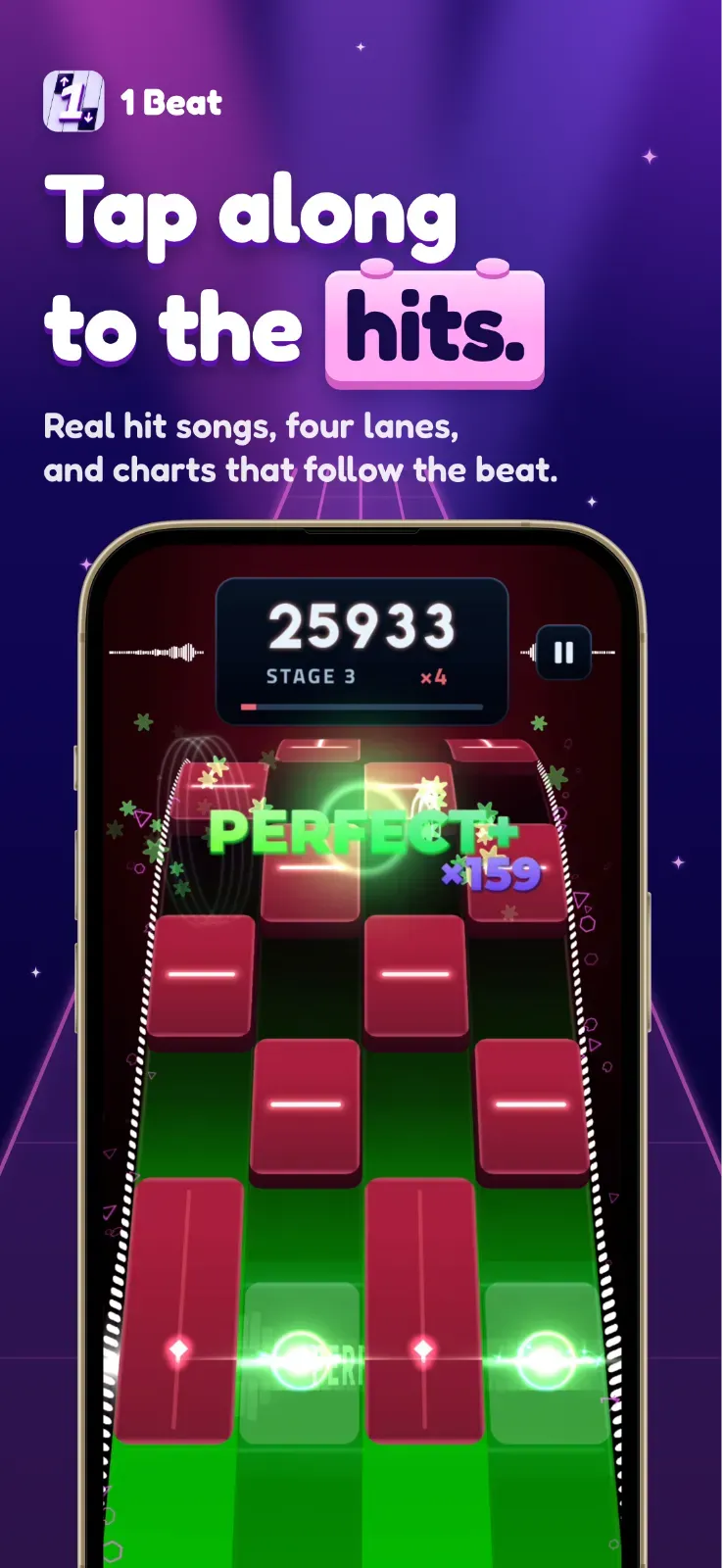
- Four-lane portrait playfield. The core design decision. Three lanes allow six ways to combine one or two simultaneous notes, while four lanes allow ten. Each thumb gets two lanes of its own, so patterns can cross, split and stack in ways a narrower board has no room for. Tap, hold and swipe remain the only three note types, so the reading skill transfers directly from Beatstar, and the added difficulty sits in density and timing rather than in new gestures.
- Tap pads positioned below the judgement line. Thumbs rest below the line where notes are read, so fingers never cover incoming notes. The site frames this as a readability choice rather than a difficulty one, and it is the kind of small layout decision that separates a chart that feels fair from one that feels hidden.
- Judgement read from the touch event. Timing is calculated from the touch input itself instead of waiting for the next rendered frame, which means a dropped frame on a slower handset does not register as a missed note. For a genre where a few milliseconds decide a score, this is a meaningful architectural detail rather than a marketing line.
- No-fail by default. A weak run ends as a weak score. There is no interruption offering a continue in exchange for watching an advertisement, a structure that is common in free mobile rhythm games and frequently criticised by players who want an uninterrupted attempt.
- Per-device audio offset. Calibration is stored per output device rather than per session, so a pair of Bluetooth earbuds and a wired headset each keep their own timing correction. The team has also published a standalone browser tool, the audio offset calculator, that measures latency on existing hardware before the game ships.
- Reduced-flashing mode. A single switch that gates every visual effect rather than applying a partial filter, aimed at photosensitive players and anyone who finds the note highway visually busy. The site describes it as an all-or-nothing toggle by design.
- Weekly leaderboards. Store screenshots show friends' scores compared on a weekly board, giving each chart a recurring competitive frame instead of a single permanent high score table.
How It Works
A run follows the established rhythm game loop. Notes descend four lanes toward a white judgement line, and the player strikes pads located beneath that line in time with the track. Hits are graded, with a PERFECT+ tier visible in the promotional screenshots, and the accumulated judgement produces a score at the end of the song. Because failure is disabled by default, the outcome of a chart is a number to beat rather than a gate to pass.
Before playing, a listener calibrates audio offset once for each pair of headphones or earbuds in use, and that value is remembered the next time the same device is connected. The public version of that process is available today through the site's browser calculator, which measures latency on a visitor's own hardware without installing anything. Access to the game itself runs through an email waitlist form: a submission is followed by a confirmation email, and the team states that the list will be used only to announce a testable build. App Store and Google Play listings are both marked as coming soon.
Use Cases
Former Beatstar players represent the clearest scenario. Beatstar's servers closed on 31 October 2025, leaving a catalogue of hand-authored charts unreachable. 1 Beat targets that audience directly, retaining the portrait layout and the three note types while adding a lane for players who had already exhausted the original difficulty ceiling.
Players on wireless audio form a second group. Bluetooth output introduces latency that a game cannot remove, but a stored per-device offset removes the repeated recalibration ritual, which matters for anyone switching between earbuds, a headset and a phone speaker across a commute.
A third case is the one-handed session. Portrait orientation and a four-lane board small enough for a thumb to cover two lanes make the format viable on a train or in a queue, without the two-hand landscape grip that most rhythm games demand. Accessibility is a fourth: the reduced-flashing switch and the no-fail default both lower the cost of trying a hard chart.
Who It's For
1 Beat is aimed at mobile rhythm players who want Beatstar's readability with a higher difficulty ceiling, and at the broader audience migrating from SuperStar, Hi Beatz, Beat Tiles or Magic Tiles 3. The absence of fail states and advertisement-driven continues suits casual players, while four-lane charting and weekly boards target score chasers. The main caveat is timing: with no build, no confirmed song list and no release date, the comparison to Beatstar is currently a design argument rather than a playable one.
Pros & Cons
The Good
- The four-lane board raises one or two note combinations from six to ten, giving chart authors more room than Beatstar's three lanes.
- Timing is judged from the raw touch event rather than the next rendered frame, so dropped frames do not register as missed notes.
- Audio offset is stored per output device, removing repeated recalibration when switching between earbuds and headsets.
- No-fail is the default, so a run ends as a score instead of a prompt to watch an advert and continue.
- A single reduced-flashing switch gates every visual effect, which is a more complete accessibility option than partial filters.
The Bad
- No build is downloadable, and the song catalogue, release window and final pricing remain unannounced.
- The team acknowledges that Bluetooth latency drift is not solved by a stored offset.
- The product's identity relies heavily on comparison with Beatstar, with no original modes or progression systems described yet.